
 Chat on WhatsApp


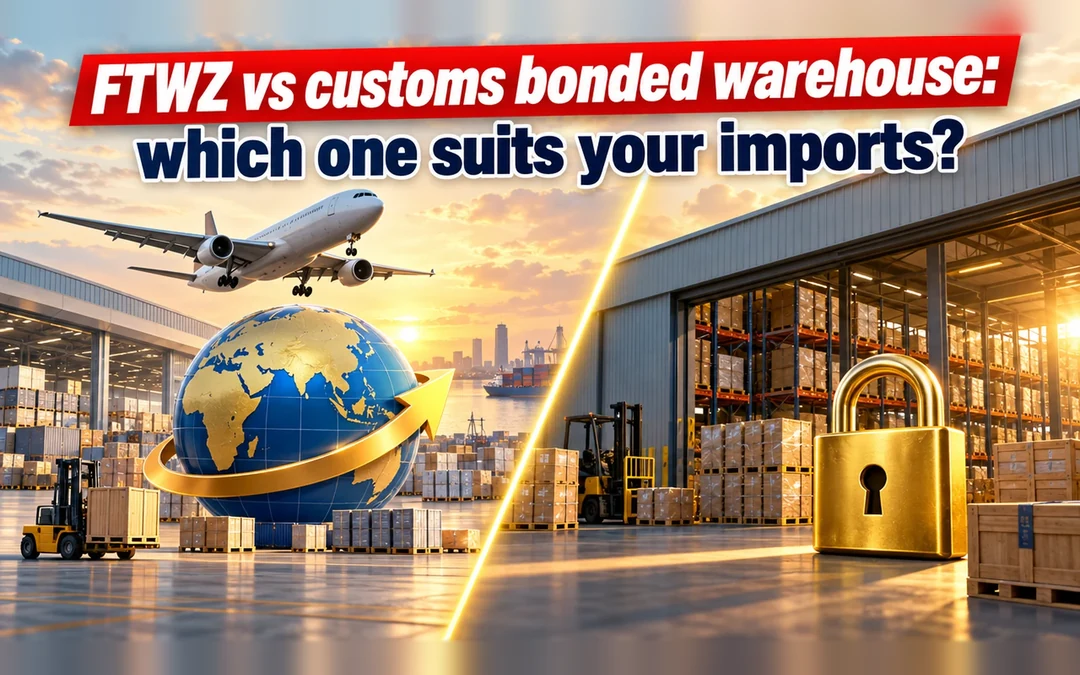
TL;DR: Both an FTWZ (free trade warehousing zone) and a customs bonded warehouse (CBW) let you store imported goods without paying duty upfront. An FTWZ is more flexible: foreign entities can hold stock, goods can stay as long as the letter of approval is valid, and more activities are allowed. A CBW is simpler but tighter: interest after 90 days and a 1-year storage limit, unless extended.
Where you store imported goods decides when you pay duty, how long the goods can wait, and what you’re allowed to do with them while they wait.
If you import or export, you’ve probably weighed 2 options: an FTWZ or a customs bonded warehouse.
Both defer duty. Beyond that, they work very differently. Pick the wrong one and you can end up paying interest on idle stock, or finding that the activity you planned isn’t allowed.
Here’s how they compare, point by point, and how to decide.
What is an FTWZ?
Short answer: A free trade warehousing zone is a type of special economic zone set up for trading and warehousing. Goods brought in from abroad don’t pay customs duty on entry. Duty is paid only when goods leave the zone for the Indian market, and goods re-exported from the zone pay none.
In short, an FTWZ gives you:
- Duty deferment until goods leave the zone
- A natural fit for re-exports and regional distribution
- No fixed storage limit, as long as the unit’s letter of approval (LOA) is valid
What is a customs bonded warehouse?
Short answer: A customs bonded warehouse is a licensed warehouse under the Customs Act, 1962 where imported goods can be stored without paying duty upfront. Duty is paid when goods are cleared for home use. Under Section 61, goods can stay for 1 year, and interest is charged once they’ve been there for more than 90 days.
In short, a CBW gives you:
- Storage with no duty paid at import
- A good fit for goods you mainly plan to sell in India
- A limited storage period
FTWZ vs customs bonded warehouse: the full comparison
| No. | Aspect | FTWZ | Customs bonded warehouse |
|---|---|---|---|
| 1 | Can a foreign entity hold inventory? | Yes | No |
| 2 | Customs duty | Deferred until clearance for home use | Deferred until clearance for home use |
| 3 | Interest-free storage | As long as the LOA is valid | 90 days; interest at 15% a year after that |
| 4 | Temporary removal (for exhibitions) | Allowed, up to 120 days | Not allowed |
| 5 | Re-export | Allowed; duty deferred and not payable on export | Allowed, with the same benefit |
| 6 | Activities allowed | Assembling, re-packing, handling, quality checks and more | Limited |
| 7 | Storing goods bought in India (DTA) | Allowed | Not allowed |
| 8 | Dollar billing to Indian (DTA) buyers | Allowed | Not allowed |
| 9 | Consolidation and partial sales | Allowed | Not allowed |
| 10 | Who’s responsible for customs compliance | The FTWZ unit operator | The trader or importer |
| 11 | Maximum storage period | As long as the LOA is valid | 1 year (extendable) |
| 12 | Marking purchase value to sale value | Possible | Not possible |
| 13 | Can the Indian buyer use FTA benefits? | Yes | Yes |

Which differences matter most?
Not all 13 rows carry the same weight. In practice, 5 of them decide most cases.
1. Who holds the stock
This is often the deciding point. In an FTWZ, a foreign entity can hold inventory in India. In a CBW, it can’t.
If you’re an overseas supplier who wants stock close to Indian customers, without setting up an Indian importer first, the FTWZ is usually the only one of the 2 that works.
2. How long goods can sit, and what that costs
In a CBW, interest runs from day 91 at 15% a year under Section 61(2), and goods can stay for 1 year. The Commissioner can extend the period, but that’s at the Commissioner’s discretion.
In an FTWZ, there’s no comparable clock. Goods can stay as long as the LOA is valid, without interest.
So the slower your stock moves, the more the FTWZ makes sense. If goods typically sell within 90 days, the CBW’s limits may never bite.
3. What you can do with the goods
An FTWZ allows a wider range of activities: assembling, re-packing, handling, quality checks and similar work.
A CBW is far more limited. Section 64 of the Customs Act lets the owner do certain things, such as inspecting goods, and sorting them or changing containers for preservation or sale, with permission. Anything that amounts to manufacturing needs a different route altogether, under Section 65 (MOOWR).
If you need real value-added work before sale, compare this with our MOOWR setup guide.
4. Partial sales and consolidation
An FTWZ lets you consolidate shipments and sell in parts. A CBW doesn’t.
For a distributor serving many smaller Indian buyers from one large import, that difference alone can settle the choice.
5. Who carries the compliance
In an FTWZ, the unit operator is responsible for complying with the customs rules. In a CBW, the trader or importer is.
That’s worth weighing honestly. An FTWZ operator takes on work you’d otherwise do yourself, but you’ll pay for that service. In a CBW, by contrast, any lapse in the bond, the records or the clearance paperwork lands on you as the importer, so make sure your team or your customs broker can carry that load.
What do both options have in common?
Some things work the same in both:
- Duty is deferred until goods are cleared for home use.
- Re-export is allowed, and duty isn’t payable on goods that leave India again.
- Indian buyers can still claim FTA benefits on the goods, where the origin rules are met.
And one GST point applies to both. Under Schedule III of the CGST Act, supplying warehoused goods to someone before they’re cleared for home use is treated as neither a supply of goods nor a supply of services. That’s what makes “sale in bond” work.
Which one fits your business?
Short answer: Choose an FTWZ if a foreign entity needs to hold stock, if goods may sit for long periods, or if you need re-packing, consolidation or partial sales. Choose a customs bonded warehouse if you’re an Indian importer whose goods mostly sell in India within a few months and need little handling.
Here’s how I’d frame it:
| Your situation | Better fit |
|---|---|
| A foreign principal wants stock in India | FTWZ |
| Goods may stay for more than 90 days | FTWZ |
| You re-export or distribute across the region | FTWZ |
| You need re-packing, assembly or quality checks | FTWZ |
| You sell in parts to many Indian buyers | FTWZ |
| You’re an Indian importer selling mainly in India | CBW |
| Goods usually move within 3 months | CBW |
| You need little or no handling before sale | CBW |

My view: for most foreign-owned or re-export-heavy supply chains, the FTWZ is the stronger option, and the extra flexibility is worth the operator’s fees. For a domestic importer with fast-moving stock, a CBW is often simpler and cheaper.
But don’t decide on the table alone. Model your actual stock-holding days, your sales pattern and your handling needs. The interest rule in Section 61 can turn a cheap warehouse into an expensive one very quickly.
Final word
The FTWZ vs customs bonded warehouse question comes down to 3 things: who owns the stock, how long it stays, and what you need to do with it before it’s sold.
Both defer duty. The FTWZ gives you more time and more freedom. The CBW gives you simplicity, with a clock that starts running after 90 days.
Before you commit, compare both against your real numbers, and look at the other options too: our customs duty savings guide covers MOOWR and FTA claims, and our EOU setup guide covers export-led manufacturing.
Choosing a warehousing model for your imports? Talk to us. Our import and export incentives review compares the options on your own data.
Author: Pradeep Reddy, CA, Founder, Unnathi Partners (formerly PwC and Deloitte)
Frequently asked questions
What is the main difference between an FTWZ and a customs bonded warehouse?
An FTWZ lets foreign entities hold stock, has no fixed storage limit while the LOA is valid, and allows more activities. A customs bonded warehouse is for Indian importers, with interest after 90 days and a 1-year storage limit.
How long can goods stay in a customs bonded warehouse?
1 year under Section 61 of the Customs Act, extendable by the Commissioner. Interest at 15% a year applies once goods have been warehoused for more than 90 days.
Can a foreign company hold inventory in India without an Indian importer?
Yes, in an FTWZ. A foreign entity can hold inventory there. It can’t do so in a customs bonded warehouse.
Is duty payable on goods re-exported from an FTWZ or a bonded warehouse?
No. In both, duty is deferred, and it isn’t payable on goods that are re-exported.
Can Indian buyers claim FTA benefits on goods from an FTWZ?
Yes. Indian buyers can claim FTA benefits on goods cleared from either an FTWZ or a customs bonded warehouse, where the origin rules are met.


We're a tax and regulatory consulting firm in Bangalore. We advise startups, MSMEs and large corporates on GST, Customs, FTP, Income Tax and FEMA, and we handle the litigation too.
Reviewed By

Handles GST and Customs advisory, compliance and notice responses. Also leads client deliverables on our Tax and Regulatory assignments.

CA with 12+ years in GST, Customs and FTP, a decade of it at PwC, Deloitte and Economic Laws Practice. Sits on KSCAA’s Indirect Tax Committee and teaches at NACIN. Speaks regularly at DGTS outreach programs.

Trackbacks/Pingbacks