 Chat on WhatsApp


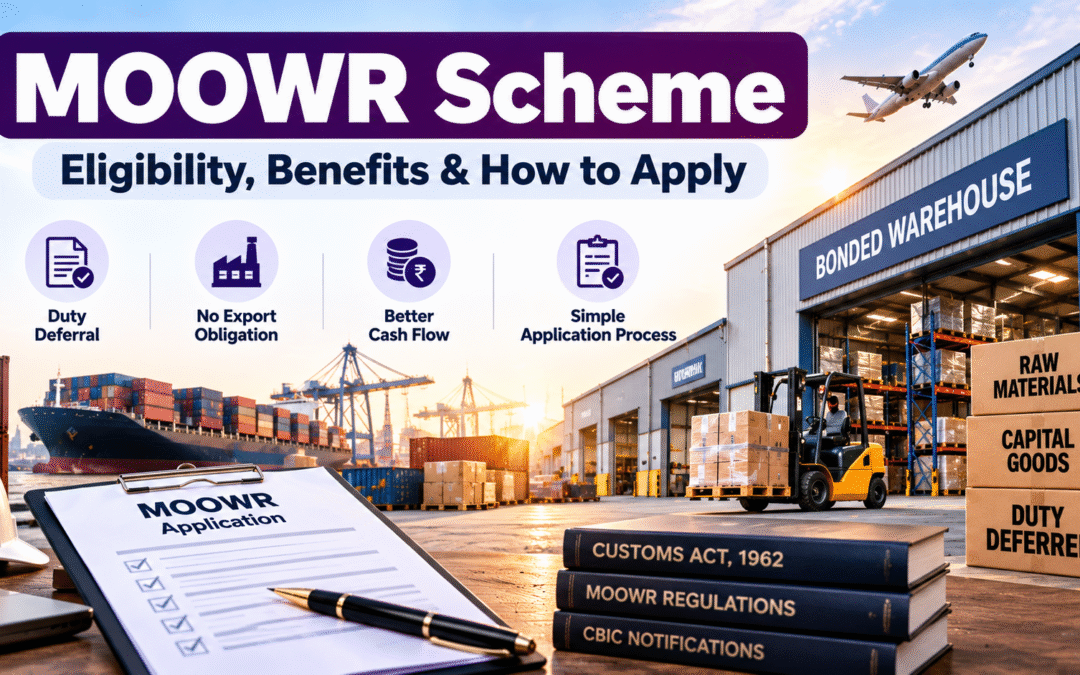
TL;DR: The MOOWR scheme (Manufacturing and Other Operations in Warehouse Regulations) lets manufacturers import raw materials and capital goods into a licensed bonded warehouse without paying customs duty upfront – duty is deferred, interest-free, until goods leave the warehouse. Unlike EPCG, it also defers Anti-Dumping Duty. There’s no turnover threshold, no export obligation, and the license runs indefinitely. The application process changed twice in late 2025: the old Invest India portal was retired on 15 November 2025, and applications now go through a dedicated MOOWR permission module on ICEGATE.
Why the MOOWR application process matters right now
The MOOWR scheme itself hasn’t changed, but how you apply has, twice, in quick succession. Through most of 2025, applications went through the Invest India portal. CBIC extended that facility in phases, first via Circular No. 19/2025-Customs to 31 October 2025, then via Circular No. 27/2025-Customs to a final cutoff of 15 November 2025.
That cutoff wasn’t a return to paper filing. CBIC operationalised a purpose-built MOOWR and MOOSWR permission module on ICEGATE under Circular No. 28/2025-Cus (15 November 2025). Section 58 and Section 65 applications under the Customs Act, 1962 are now filed through this module – the process stayed digital, it just moved onto CBIC’s own systems.
This post covers MOOWR scheme eligibility, MOOWR scheme benefits, the current MOOWR scheme application process, and a checklist to work through before you file.
What is the MOOWR scheme?
The MOOWR scheme lets a manufacturer operate a private bonded warehouse under Section 65 of the Customs Act, 1962, where imported inputs and capital goods are stored and used for manufacturing without paying customs duty at import. Duty becomes payable only when finished goods (or the inputs themselves) clear the warehouse – and if the finished goods are exported, no duty is payable on the imported input content at all. Unlike Advance Authorization, EPCG, EOU, or SEZ, MOOWR carries no export obligation, so it suits any manufacturer regardless of size, location, or investment.
This differs from a standard duty drawback or export incentive scheme: MOOWR doesn’t require you to export anything, and no interest is charged on the deferred duty while goods stay bonded. You can sell the entire output domestically and still defer duty until clearance – a cash-flow benefit rather than an export subsidy.
How MOOWR compares to EPCG on Anti-Dumping Duty
EPCG exempts Basic Customs Duty, IGST, and Compensation Cess on capital goods – but not Anti-Dumping Duty, which is payable upfront regardless. MOOWR defers all of it: BCD, IGST, ADD, Social Welfare Surcharge, and Compensation Cess. Nothing is paid until goods clear for domestic use, and if the capital goods are re-exported after their working life, the deferred duties are extinguished. For manufacturers importing ADD-heavy capital goods, that difference alone can decide between the two schemes.
MOOWR Scheme Eligibility: Who Can Apply?
Any manufacturer with a valid IEC and GST registration can apply – no minimum turnover, no mandatory export obligation, and no bank guarantee requirement, unlike older bonded manufacturing schemes.
Both manufacturing units and those combining manufacturing with trading in imported inputs and capital goods can qualify. The core requirement is operational: your facility must meet bonded warehouse standards, with Customs supervision, digital stock records, and periodic audits for as long as you hold the license.
MOOWR Scheme Benefits
The headline MOOWR scheme benefit is duty deferral on capital goods and raw materials, freeing up working capital otherwise locked in upfront customs duty.
- No export obligation – domestic-focused manufacturers benefit as much as exporters
- No fixed expiry once the license is granted
- No interest on deferred duty for raw materials sold domestically, and no duty on inputs used in exported goods or capital goods re-exported after their working life
- Budget 2026 removed prior permission requirements for inter-warehouse transfers of bonded goods, following the substitution of Section 67
- Meaningful project-financing impact for capital-intensive sectors like electronics, EV components, and machinery assembly
What compliance obligations come with a MOOWR license?
Every MOOWR license carries a set of ongoing obligations:
- A bill of entry for warehousing on every import, with no duty or IGST paid upfront
- A separate bill of entry for home consumption on each domestic sale of finished goods, traced to the original import – five inbound consignments means five filings at sale time, a real load when sourcing spans multiple shipments
- Return of job-worked goods, including tools and moulds, within a year
- A GST invoice, e-way bill, and export proof filed with the bond officer within a month for export clearances
- Records tracking receipt, processing, and removal using FIFO, with domestic and imported stock kept separate
- A designated warehouse keeper and monthly returns filed by the 10th of the following month
CBIC’s Circular No. 26/2024-Customs confirms a MOOWR unit can simultaneously avail IGCR concessional-rate benefits and MOOWR deferment, provided both schemes’ conditions are met.
The MOOWR Scheme Application Process, Step by Step
Applications for a Section 58 private bonded warehouse license and Section 65 manufacturing permission are filed through the MOOWR permission module on ICEGATE, per Circular No. 28/2025-Cus. The Invest India microsite that previously hosted this process is no longer in use.
The process includes the following steps:
- Eligibility and premises assessment
- Application filing with supporting documents (IEC, GST registration, warehouse layout, process flow)
- Execution of a bond
- Physical inspection by customs officers
- Issuance of the license by the jurisdictional Commissioner
Published turnaround times aren’t available yet, so confirm current timelines with your Commissionerate before committing to a project schedule.
What are the trade-offs of choosing MOOWR?
MOOWR isn’t cost-free. Capital goods sold domestically attract duty on their full original import value, with no depreciation allowance for years of use. MOOWR-based exports also don’t qualify for RODTEP scrips or Duty Drawback, benefits typically worth 4 to 5% of export value, so exporters should weigh that loss against the deferment gains. A further complication: the Finance Act 2024 empowers the government to exclude specific goods or operations from MOOWR, adding uncertainty to long-term planning.
Checklist: MOOWR application readiness
- Confirm valid IEC and GST registration are in place before applying
- Assess whether your facility meets bonded warehouse premises requirements
- Prepare process flow documentation showing how imported inputs convert to finished goods
- Draft the Section 58/65 application for the ICEGATE MOOWR permission module, plus the required bond
- Set up digital stock records, FIFO tracking, and a designated warehouse keeper ahead of inspection
- Confirm interaction with any existing IGCR concessional-rate imports before combining schemes
- Weigh the loss of RODTEP/Drawback eligibility against duty deferment benefits for export-heavy operations
- Calendar monthly returns (10th of the following month) and periodic audits once licensed
FAQ
Does the MOOWR scheme require me to export my finished goods?
No. You can sell 100% of your output domestically and still get the duty deferral benefit. Export is optional, not a condition of the scheme.
How long is a MOOWR license valid?
Once granted, the license has no fixed expiry and continues as long as you meet ongoing obligations – digital stock records, customs supervision, and periodic audits.
Can I still apply for MOOWR through the Invest India portal?
No. The Invest India facility closed on 15 November 2025. Applications now go through the MOOWR permission module on ICEGATE.
What happens when I clear goods out of the bonded warehouse?
Duty becomes payable then, calculated on the imported input content, unless the finished goods are being exported, in which case that duty isn’t payable.
Conclusion
MOOWR remains one of the more flexible duty deferral tools available to Indian manufacturers – no export obligation, no turnover threshold, interest-free deferral, and a license that doesn’t expire. Set against that are real costs: multiple bills of entry per domestic sale, no depreciation relief on capital goods sold in India, and the loss of RODTEP or Drawback on exports. If you’re evaluating MOOWR for a new facility, talk to Unnathi Partners before drafting your application.
Related reading: see our SVB customs rules and clearance process guide (svb-customs-rules-and-clearance-process); exporters combining MOOWR with AEO status should see our AEO certification guide (aeo-certification-india-guide) and AEO T1 vs T2 vs T3 comparison (aeo-t1-vs-t2-vs-t3-guide).
External reference: CBIC Circular No. 28/2025-Cus, dated 15 November 2025, operationalising the MOOWR/MOOSWR permission module on ICEGATE – cbic.gov.in
Tags: MOOWR scheme, bonded warehouse, Section 65 Customs Act, ICEGATE, duty deferral, manufacturing compliance, IGCR, Customs Act 1962, import duty, warehouse license.
Want Us on Your Side?
Related reading: setting up an EOU unit


We're a tax and regulatory consulting firm in Bangalore. We advise startups, MSMEs and large corporates on GST, Customs, FTP, Income Tax and FEMA, and we handle the litigation too.
Reviewed By

Handles GST and Customs advisory, compliance and notice responses. Also leads client deliverables on our Tax and Regulatory assignments.

CA with 12+ years in GST, Customs and FTP, a decade of it at PwC, Deloitte and Economic Laws Practice. Sits on KSCAA’s Indirect Tax Committee and teaches at NACIN. Speaks regularly at DGTS outreach programs.

Trackbacks/Pingbacks