 Chat on WhatsApp


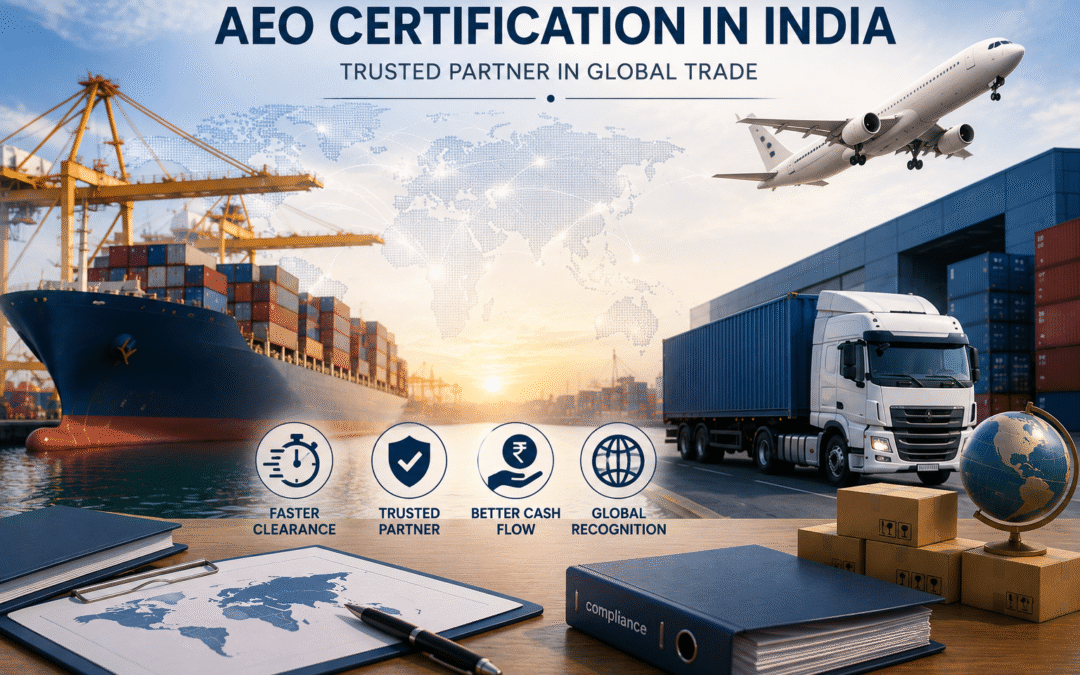
TL;DR: AEO certification is CBIC’s trusted-trader status for importers, exporters, and logistics operators with a clean compliance record. It comes in three tiers (T1, T2, T3) plus a logistics-operator category, and the payoff scales with the tier: faster clearance and a partial bank guarantee waiver at T1, deferred duty payment at T2, and a full bank guarantee waiver plus mutual recognition abroad at T3.
Most importers and exporters only hear about AEO certification when a freight forwarder mentions it as the reason a competitor’s containers clear faster while theirs sit for inspection. An Authorized Economic Operator is a business CBIC has certified as low-risk under the World Customs Organization’s SAFE Framework, and customs AEO certification rewards clean records with faster clearance, fewer inspections, and better cash flow on duty. This guide covers AEO certification requirements, the tiers, AEO registration, and a checklist before you file application for AEO registration.

What Is an Authorized Economic Operator, and Who Is AEO India For?
An Authorized Economic Operator is a business CBIC has voluntarily certified. Importers, exporters, custodians, freight forwarders, warehouse operators, and customs brokers can all hold AEO India status as low-risk, compliant trade partners. Introduced in 2011 and restructured in 2016, CBIC merged the older Accredited Client Programme into a unified three-tier AEO structure under Circular No. 33/2016-Customs.
Any business regularly engaging in import, export, or customs-adjacent logistics can apply, but it makes the most sense for entities moving enough volume that the benefits translate into real savings.
AEO Certification Requirements: Who Is Eligible?
You need at least three financial years of documented business activity in India and a minimum of 25 customs documents – Bills of Entry or Shipping Bills – filed in that period, though the AEO Programme Manager can waive this for newer entities in specific cases.
Beyond transaction history, CBIC checks financial solvency, no serious customs, GST, or tax offence in the preceding three years, documented internal controls, and adequate premises security. None of this turns on a single missed filing.
Does a Pending Show Cause Notice Hurt Your AEO Renewal or Upgrade?
Yes – Circular 33/2016-Customs sets out three specific conditions CBIC checks at T2 renewal or T3 upgrade, and a badly-timed SCN under Section 28(4) can stall an otherwise clean application.
- No SCN for serious offences: no show cause notice in the last 3 financial years for fraud, forgery, outright smuggling, clandestine removal of excisable goods, or non-deposit of service tax collected from customers.
- No prosecution: no prosecution launched or being contemplated against the company or its senior management.
- 10% duty-dispute threshold: for all other SCNs, if the disputed duty or drawback demand over the last 3 years exceeds 10% of total duty paid and drawback claimed, the AEO Programme Manager reviews the case before deciding – not an automatic rejection.
SCNs dropped or decided in your favour by an adjudicating or appellate authority are excluded entirely. In practice: get SCNs under Section 28(4) concluded before you file, since those sit in the first condition; a Section 28(1) SCN is usually fine as long as the disputed duty stays under 10% of duty paid in the last 3 years.
AEO T1 vs. T2 vs. T3: What’s the Difference?
The tier you qualify for under AEO certification in India determines both how invasive the review is and how much benefit you get.
| Tier | Review type | Bank guarantee waiver | Duty payment |
|---|---|---|---|
| AEO-T1 | Desk-based document review | 50% | Standard |
| AEO-T2 | Desk review plus site inspection | 75% | Deferred, due 15th of next month |
| AEO-T3 | Site inspection, after 2 years as T2 | 100% (nil) | Deferred, same as T2 |
There’s also AEO-LO, a parallel category for custodians, freight forwarders, and warehouse keepers, scoped to their supply-chain role rather than import/export duty.
How Does AEO Registration Work? Step-by-Step Process
AEO registration runs through the aeoindia.gov.in portal. CBIC has trimmed the process in recent years – T1 annexures were cut from 7 to 2, and T1 approvals now happen at the Zonal Customs level instead of Delhi.
- Register on the portal and select the tier you’re applying for
- Complete the self-assessment questionnaire and submit Annexure A-1, plus A-2 or A-3 depending on tier and category
- Attach core documents: incorporation certificate, GSTIN and IEC registration, 3 years of audited financials, GST returns, and written SOPs for cargo handling, customs compliance, and security
- T1 gets a paper review; T2 and T3 also trigger a physical site visit
- Respond quickly to any deficiency memo – most delays come from slow document turnaround, not the review itself
AEO Certificate Benefits by Tier
AEO certificate benefits get stronger at each tier. All three levels get Direct Port Delivery and Direct Port Entry, a dedicated client relationship manager, and fewer random examinations at the port. T2 and T3 add deferred duty payment, so goods clear before duty is paid, freeing up working capital otherwise locked in customs escrow.
T3 status is also recognized under India’s Mutual Recognition Agreements with partner customs administrations including South Korea, UAE, Hong Kong, Taiwan, and Singapore – AEO-certified shipments get reciprocal facilitation abroad too.
Not AEO-Certified Yet? The EMI Scheme Also Defers Duty
A new category, Eligible Manufacturer Importers (EMI), can now defer customs duty payment without an AEO licence – it’s a bridge into AEO T2/T3, not a replacement for it.
Deferred duty was previously an AEO-only benefit; manufacturers without it paid duty upfront on every shipment, tying up capital before goods left port. EMI extends that benefit to a wider set of manufacturers, with the expectation they work toward AEO T2/T3 within 2 years of entry.
AEO Certification Checklist
- Confirm 3 financial years of documented import/export activity, or grounds for a waiver
- Count at least 25 Bills of Entry or Shipping Bills filed in the relevant period
- Check for any open SCN in the last 3 years – resolve or evaluate its impact before filing
- Pull financial statements for the last 3 years and confirm no solvency red flags
- Document your internal control, record-keeping, and security procedures in writing
- Gather certificate of incorporation, GSTIN, and IEC registration
- Register on aeoindia.gov.in and file Annexure A-1 plus the tier-specific annexure
Internal reading: see our guides on SVB customs rules and clearance process, and the MOOWR scheme eligibility and benefits for related customs compliance topics.
FAQ
How long does AEO certification take in India?
AEO-T1 typically takes 1 to 2 months since it’s a desk-based document review. AEO-T2 and T3 usually take 3 to 6 months because they include a physical site inspection.
Can a small business or MSME apply for AEO certification?
Yes. CBIC introduced a Liberalised MSME AEO Package under Circular No. 54/2020-Customs to lower the compliance burden for smaller entities.
Does an old, resolved SCN still hurt an AEO application?
Not if resolved fully in your favour, or more than 3 years old from your application date – both fall outside the disqualification window under Circular 33/2016.
Does AEO certification expire?
AEO status isn’t granted for a fixed term but stays subject to ongoing monitoring – CBIC can suspend or revoke it if compliance deteriorates or a serious offence comes to light.
Conclusion
AEO certification isn’t a formality – it’s a trade-off between proving your compliance record and the working-capital and clearance-speed benefits once CBIC signs off. The T2 deferred-duty benefit often pays for the compliance effort within a year, and T3 status can change how partner-country customs treat your shipments. If EMI status, an open SCN, or a renewal/upgrade review could affect your eligibility, Unnathi Partners’ indirect tax team can review your position before you file.