 Chat on WhatsApp



TL;DR: A GST refund for exporters works one of two ways: either you pay IGST on the export and get it back automatically once your shipping bill matches your GSTR-1 and GSTR-3B (Rule 96), or you export under a Letter of Undertaking without paying IGST and claim back accumulated input tax credit through Form RFD-01 (Rule 89). Most delayed refunds trace back to a handful of repeat mistakes, not the law itself.
Exporters routinely leave working capital sitting with the department for months because the refund route doesn’t match how their business runs, or a small documentation gap holds up a valid refund claim. This guide walks through the GST refund process for exporters: which route to pick, the mistakes that stall refunds most, the procedure for refund in case for exporters of goods and services, and a checklist before you file a refund application.
For example, an export-oriented manufacturer filing under LUT often sees refunds stall not because of the law, but because purchase register entries don’t tie out to the ITC claimed in RFD-01. Monthly reconciliation avoids that.
7 Mistakes That Stall GST Refunds for Exporters
The same errors show up across SaaS companies, manufacturers, and high-value goods exporters – small mismatches, not complex law, are what tie up crores in refunds.
- Picking the wrong route, or picking one without a plan: paying IGST when LUT would suit you better, or the other way around. Some exporters do better paying IGST and claiming it back; others do better on LUT. Choose without checking your cash flow first, and it costs you money.
- Invoice doesn’t match the shipping bill: if the currency, port code, or invoice number differs, ICEGATE rejects the claim automatically.
- Filed at the port but missed in GSTR-1: the goods clear customs, but the invoice never shows up in GSTR-1. With no matching invoice, no refund gets paid.
- Missed refund on capital goods: exporters who pay IGST can also claim credit on capital goods, but most never apply for it. This only works on the IGST-paid route – the LUT route leaves out capital goods credit and blocked credits under Section 17(5) when working out the refund.
- Payment received late: FEMA gives you 9 months from the export date to receive payment in foreign currency. Miss that window, and the refund gets reversed, with penalties.
- HSN/SAC code missing from the ITC register: mandatory for every line item under CBIC Circular 135/05/2020-GST – officers check it, and it’s a top reason claims draw a deficiency memo.
What Is a GST Refund for Exporters, and Why Does It Exist?
Exports are treated as zero-rated supplies under Section 16 of the IGST Act, so an exporter shouldn’t bear GST on inputs or the export itself. The law builds in two mechanisms: an automatic refund of IGST paid on export, or a refund of ITC that piled up because the export was made without paying IGST.
Either way, you have 2 years to file, and the clock starts differently by type: for goods, the shipping bill/EGM date; for services, the forex realization date on the BRC/FIRC.
IGST Route vs. LUT Route: Which Should You Choose?
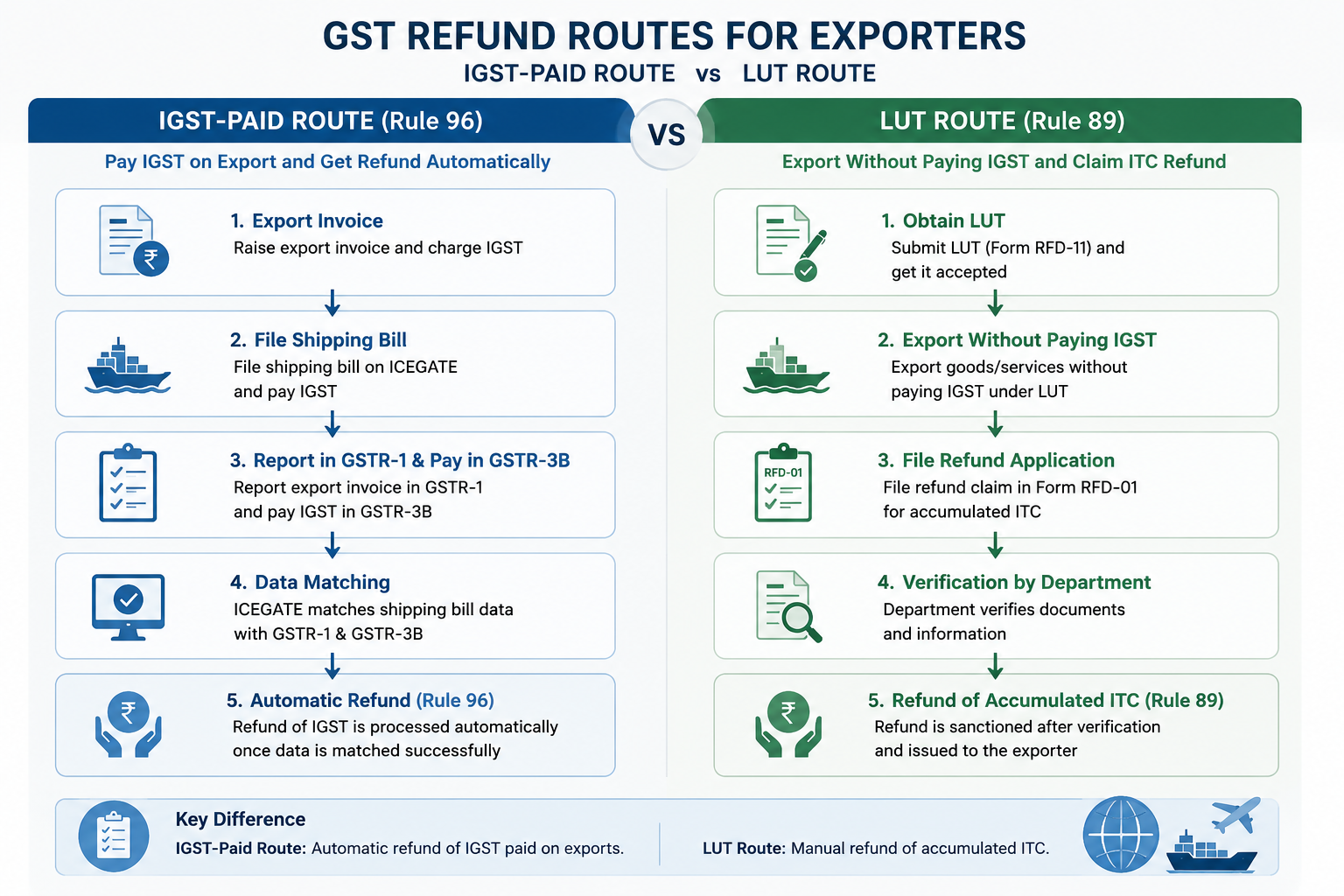
The right route depends on how much cash you can tie up with the department while a refund processes. The table below illustrates how both routes work for exporters of goods; for exporters of services, the refund mechanism is the same under both routes.
| Route | How it works | Refund mechanism | Best for |
|---|---|---|---|
| IGST paid (Rule 96) | Pay IGST on export invoice, claim it back | Automatic, via shipping bill matched to GSTR-1/3B | Strong working capital |
| LUT (Rule 89) | Export without paying IGST, using Form RFD-11 | Manual claim of accumulated ITC via Form RFD-01 | Avoiding upfront tax funding |
The LUT itself is valid for one financial year and must be renewed before your first export of each year – missing that renewal is a common, avoidable reason refunds get delayed. The refund is capped by the Rule 89(4) formula: Maximum Refund = Net ITC x (Zero-Rated Turnover / Adjusted Total Turnover).
GST Refund Procedure for Export of Goods and Services
The GST refund procedure for export of goods with payment of tax treats the shipping bill as the refund application itself. ICEGATE data is matched against GSTR-1 and GSTR-3B, and the refund releases automatically once it reconciles – but only if the Export General Manifest (EGM) has been filed. No EGM, no refund on that shipping bill.
The GST refund procedure for export of goods without payment of tax runs through Form RFD-01, and zero-rated supplies must be reported in GSTR-1 Table 6A for exports or Table 6B for SEZ supplies – the wrong table is a common cause of a stuck claim. The GST refund procedure for export of services follows the same RFD-01 route, but with no shipping bill to anchor it – a BRC or FIRC has to prove the export and payment happened.
GST Refund Timelines: RFD-02, RFD-03, and the 60-Day Window
Once you file RFD-01, the department acknowledges it in Form RFD-02 within 7 days if complete. If documents are missing, a deficiency memo in Form RFD-03 goes out within 7 days instead, and the clock resets on re-filing.
For zero-rated claims, 90% is released provisionally within 3 days via Form RFD-04, with the balance settled in Form RFD-06. The full claim must be sanctioned within 60 days; if not, the department owes 6% annual interest. A rejection comes as Form RFD-08, with a chance to reply before it’s finalized.
GST Refund for Exporters Checklist
- Confirm whether you have exported with payment of IGST or LUT route, matching how you filed
- If on LUT, verify it’s current for this year – renew before your first export, if not
- Reconcile shipping bill data against GSTR-1 details, including currency and port code
- Confirm GSTR-3B payment matches the IGST shown on the shipping bill
- For services, gather the BRC/FIRC and confirm currency realized within the FEMA 9-month window
- Check ITC claimed, including capital goods and Section 17(5) exclusions, matches your purchase register
Related reading: our guides on GST show cause notice replies and Section 54 GST refund eligibility cover the compliance side of this process; our AEO certification guide is useful if export facilitation status is on your radar.
FAQ
How long does a GST refund take for exporters?
Under the IGST-paid route, refunds are typically automatic and fast once shipping bill and return data reconcile, often within weeks from the date of filings of GST returns. Under the LUT/RFD-01 route, 90% is released provisionally within 7 days, with full sanction due within 60 days.
What happens if my refund application gets a deficiency memo?
A deficiency memo in Form RFD-03 means your application is treated as not filed, and you’ll need to correct the flagged issue and resubmit under a fresh ARN. The 2-year window doesn’t pause for this, so re-file immediately.
Can I lose a GST refund if foreign currency comes in late?
Yes. FEMA requires export proceeds to be realized within 9 months of export – miss it and a refund already sanctioned can be reversed, with penalties added.
Conclusion
A GST refund for exporters isn’t complicated in principle, but it punishes small documentation gaps disproportionately – the same handful of mistakes shows up across SaaS companies, manufacturers, and goods exporters alike. Picking the right route and keeping records reconciled is most of the battle. If your refunds are consistently slow, Unnathi Partners’ indirect tax team can review your filing process.