
 Chat on WhatsApp



GSTR-9C: Applicability, Format & Penalty
TL;DR: GSTR-9C applicability starts at ₹5 crore of aggregate turnover. If you cross it, you file GSTR-9C with GSTR-9 by 31 December 2026 (FY 2025-26). File it late and the Section 47(2) late fee keeps running.
Every December, your GST returns say one thing about turnover and your audited accounts say another. Awkward. GSTR-9C is where you settle the argument.
Most notices we see start with a mismatch someone assumed was too small to matter. So start the reconciliation now, not on 30 December.
Here’s who files, the GSTR-9C due date, the GSTR-9C format and the GSTR-9C penalty, in the order you’ll need them.
What is GSTR-9C?
GSTR-9C is a reconciliation statement under Section 44 of the CGST Act, read with Rule 80(3). It lines up the turnover, tax paid and input tax credit (ITC) in your annual return against your audited financial statements. Every number that doesn’t match needs an explanation.
Until FY 2019-20, a CA or CMA certified it. From FY 2020-21, you certify it yourself (Notification No. 30/2021-CT).
| Point | GSTR-9 | GSTR-9C |
|---|---|---|
| Nature | Annual return | Reconciliation statement |
| Who files | Turnover above ₹2 crore | Turnover above ₹5 crore |
| Compares | GSTR-1, 3B and 2B data | GSTR-9 vs audited accounts |
GSTR-9C applicability: who needs to file?
If your aggregate turnover is above ₹5 crore in the financial year, you file GSTR-9C. Turnover is counted by PAN across all states, but the form is filed separately for each GSTIN.
Turnover limit for GSTR-9C
The ₹5 crore limit sits in Rule 80(3). “Aggregate turnover” under Section 2(6) includes taxable, exempt and export supplies of every GSTIN under one PAN.
Example: ₹3 crore in Karnataka plus ₹2.5 crore in Telangana is ₹5.5 crore. Both GSTINs file GSTR-9C.
Businesses required to file GSTR-9C
Every regular taxpayer who files GSTR-9 with turnover above ₹5 crore, SEZ units included.
Exemptions and exceptions, if applicable
- Government departments and local authorities audited by the CAG (Section 44(1), second proviso)
- Persons outside GSTR-9: composition taxpayers, Input Service Distributors, casual and non-resident taxable persons, and TDS/TCS registrants
- Non-resident providers of online information and database access (OIDAR) services
| Aggregate turnover | GSTR-9 | GSTR-9C |
|---|---|---|
| Up to ₹2 crore | Exempt from FY 2024-25 (Notification 15/2025-CT) | Not required |
| ₹2 crore to ₹5 crore | Mandatory | Not required |
| Above ₹5 crore | Mandatory | Mandatory, self-certified |
Not sure whether your group crosses ₹5 crore on a PAN basis? Send us your GSTIN-wise turnover and we’ll tell you.
What is the GSTR-9C due date?
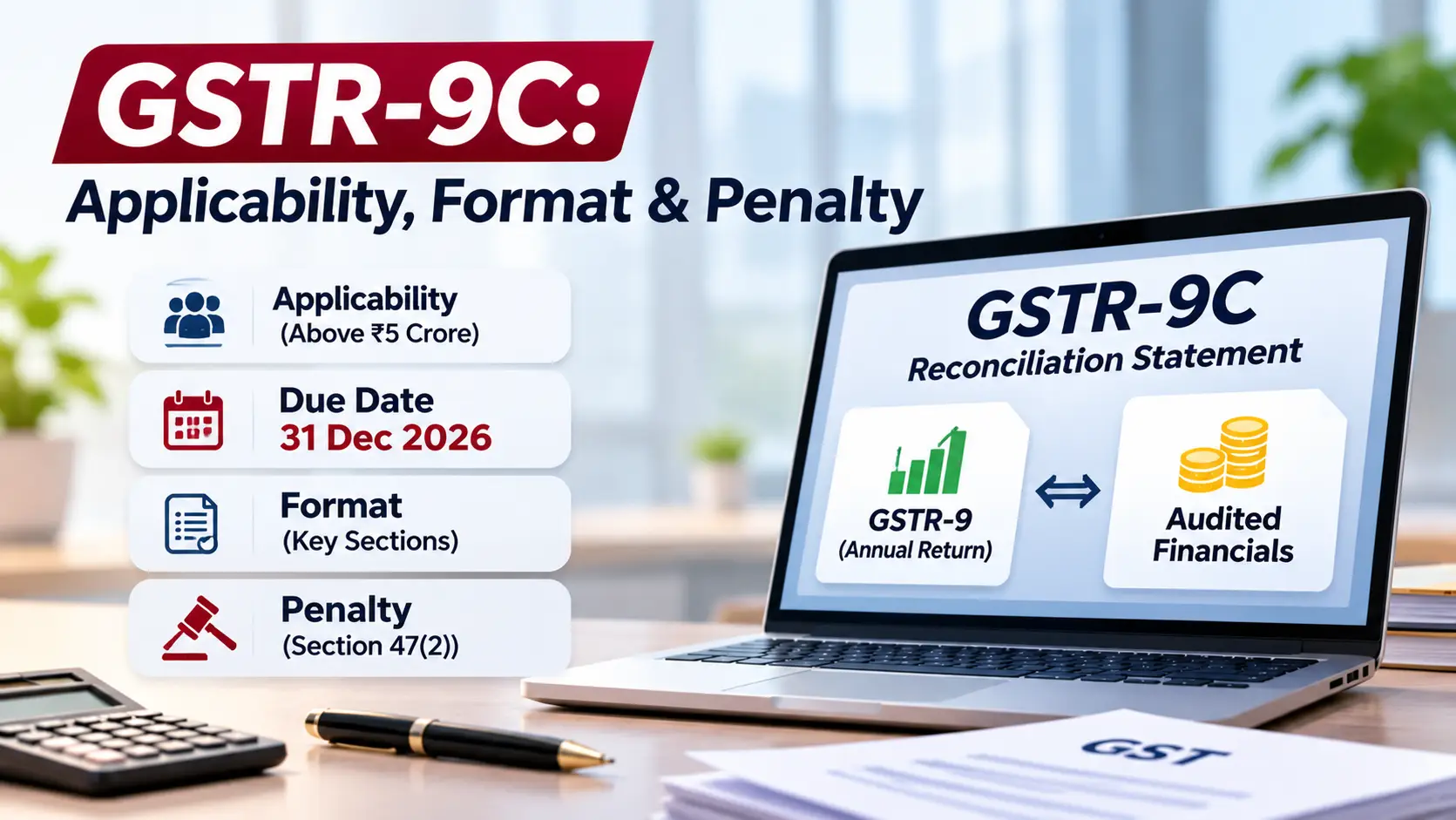
The GSTR-9C due date is 31 December after the financial year ends, the same as GSTR-9. For FY 2025-26, that’s 31 December 2026. No extension has been notified as of 29 October 2026.
- GSTR-9C opens only after you file GSTR-9, which opens only after every GSTR-1 and GSTR-3B.
- Missed ITC for FY 2025-26 can be claimed only until 30 November 2026 (Section 16(4)). Reconcile ITC first.
- Section 44(2) bars filing after 3 years from the due date.
If you miss the date, the late fee starts the next day. It keeps running until GSTR-9C is filed, and unexplained differences invite scrutiny.
| Financial year | Due date | Notification / status |
|---|---|---|
| FY 2023-24 | 31 December 2024 | No extension |
| FY 2024-25 | 31 December 2025 | No extension; revised forms (Notification 13/2025-CT) |
| FY 2025-26 | 31 December 2026 | None notified as of 29 October 2026 |
GSTR-9C format and required documents
Key sections of the GSTR-9C format
| Part | What it covers |
|---|---|
| Part I: Basic details | GSTIN, financial year, audit under other laws |
| Part II: Turnover | Audited accounts vs GSTR-9 |
| Part III: Tax paid | Rate-wise tax payable vs tax paid |
| Part IV: ITC | ITC in books vs ITC in GSTR-9 |
| Part V: Additional liability | Extra tax and interest on differences; late fee |
Notification 13/2025-CT (17 September 2025) revised the form. It added e-commerce rows and a late fee table, and lets you pay Part V liability in cash or ITC. Always download the latest form and instructions from the official GST portal.
Documents required for filing GSTR-9C
| Document | Why you need it |
|---|---|
| Audited financial statements | Base figures for Parts II and IV |
| GSTIN-wise trial balance | Splits PAN-level accounts by GSTIN |
| Filed GSTR-9, GSTR-1, 3B, 2B | What GSTR-9C reconciles against |
| Credit and debit note registers | Separates Section 34 notes from commercial notes |
| ITC reversal workings | Rule 42, Rule 43 and Section 17(5) |
Turnover and input tax credit reconciliation
Turnover gaps usually come from unbilled revenue, advances, commercial credit notes and stock transfers between GSTINs. ITC gaps come from blocked credits and claims that belong to another year.
What is the GSTR-9C penalty for late or non-filing?
The late fee comes from CBIC Circular No. 246/03/2025-GST (30 January 2025). It says your annual return is complete only when both GSTR-9 and GSTR-9C are filed, so the Section 47(2) late fee keeps running until GSTR-9C is in.
Late filing consequences
Rates apply from FY 2022-23 (Notification 07/2023-CT). Taxpayers below ₹5 crore don’t file GSTR-9C, so the lower slabs affect GSTR-9 alone.
Penalties for non-compliance
A late fee, a penalty and interest are separate charges. Mismatched numbers can bring scrutiny under Section 61 and demands under Sections 73, 74 or 74A.
Officers sometimes add a Section 125 penalty (up to ₹25,000 under the CGST Act) on top of the late fee. The Madras High Court has held that a Section 47 late fee rules it out (Tvl. Jainsons Castors, W.P. No. 36614 of 2024). Worth quoting in your reply.
Interest on unpaid tax, where applicable
Section 50 interest applies to extra tax found in Part V. If ITC is wrongly availed and used, it rises to 24% a year.
| Type of non-compliance | Consequence | Provision |
|---|---|---|
| Late filing, ₹5 crore to ₹20 crore | ₹100/day (₹50 CGST + ₹50 SGST). Cap: 0.04% of State turnover. | Section 47(2); Notification 07/2023-CT |
| Late filing, above ₹20 crore | ₹200/day (₹100 + ₹100). Cap: 0.5% of State turnover. | Section 47(2) |
| Short-paid tax | Interest on the unpaid tax | Section 50 |
| Unexplained differences | Scrutiny, then demand | Sections 61, 73, 74 |
Got a late fee or a notice on GSTR-9C differences? Send us the notice and your filed GSTR-9 before you reply to it.
How to file GSTR-9C online
- Reconcile first. Match audited accounts with GSTR-9. Fix mismatches before you open the form.
- File GSTR-9. Every GSTR-1 and GSTR-3B must be filed. The GSTR-9C tile stays locked until you do.
- Prepare the JSON. On the portal, go to Services > Returns > Annual Return. Use the offline utility to enter figures, validate and generate the file.
- Upload with accounts. Attach audited financial statements as a PDF (max 5 MB).
- Pay Part V liability. Use DRC-03 with “Annual Return” as the cause of payment.
- Preview and file. Check the draft, tick the declaration, and sign with DSC or EVC.
You can’t revise GSTR-9C once it’s filed, so check every discrepancy before you submit.
Common mistakes to avoid while filing GSTR-9C
- Testing GSTR-9C applicability per GSTIN instead of per PAN
- Reconciling ITC after the 30 November cut-off
- Filing GSTR-9C late because GSTR-9 went in on time
Frequently asked questions
What is the turnover limit for GSTR-9C applicability?
Aggregate turnover above ₹5 crore in the financial year, counted across all GSTINs under one PAN.
What is the GSTR-9C due date?
31 December after the financial year ends. For FY 2025-26: 31 December 2026, unless extended.
Is GSTR-9C mandatory for all GST-registered businesses?
No. It is mandatory only above ₹5 crore of aggregate turnover, for taxpayers who file the annual return.
What is the difference between GSTR-9 and GSTR-9C?
GSTR-9 summarises the year’s returns. GSTR-9C checks that summary against your audited accounts.
What is the GSTR-9C penalty for late filing?
Section 47(2) late fee, from the due date until the complete annual return is filed: ₹100 a day (₹5-20 crore) or ₹200 a day (above ₹20 crore), subject to caps.
Can GSTR-9C be revised after filing?
No. Pay any extra tax later through DRC-03 with interest.
Is a Chartered Accountant required to certify GSTR-9C?
No. It has been self-certified since FY 2020-21.
Get GST compliance assistance from Unnathi Partners
Unnathi Partners is a Bengaluru tax practice led by Chartered Accountants with Big 4 experience. We prepare GSTR-9 and GSTR-9C, reconcile books with returns across GSTINs, catch differences before they become notices, and handle replies and appeals.
Need GSTR-9C filed before 31 December 2026? Send us your audited accounts and filed GSTR-9 through our contact page. We’ll review the reconciliation and tell you what needs fixing.
Disclaimer: General information only, not legal or tax advice. Position as of 29 October 2026. Check the latest CBIC notifications before acting.
Author: Pradeep Reddy, CA. Founder, Unnathi Partners; formerly PwC and Deloitte.
Tags: GSTR-9C, GSTR-9C applicability, GSTR-9C due date, GSTR-9C format, GSTR-9C penalty, GST annual return, GST reconciliation statement, Section 44 CGST, GST late fee, GST compliance


We're a tax and regulatory consulting firm in Bangalore. We advise startups, MSMEs and large corporates on GST, Customs, FTP, Income Tax and FEMA, and we handle the litigation too.
Reviewed By

Handles GST and Customs advisory, compliance and notice responses. Also leads client deliverables on our Tax and Regulatory assignments.

CA with 12+ years in GST, Customs and FTP, a decade of it at PwC, Deloitte and Economic Laws Practice. Sits on KSCAA’s Indirect Tax Committee and teaches at NACIN. Speaks regularly at DGTS outreach programs.