 Chat on WhatsApp



TL;DR: Section 54 of the CGST Act lets you claim a refund on zero-rated exports, accumulated ITC from an inverted duty structure, excess cash ledger balance, wrongly paid tax, and a few other categories. Claims are filed electronically through Form RFD-01 within two years of the relevant date. A pending Finance Act 2026 amendment would extend provisional refunds to inverted duty structure claims too, but automated risk screening can route claims to full scrutiny instead.
Why Section 54 GST Refund Rules Need Fresh Attention
GST refund processing keeps evolving. Section 155 of the Finance Act 2026 extends the 90% provisional window to inverted duty structure claimants, not just zero-rated exporters – a cash flow win once notified, though the effective date isn’t announced. Separately, from May 2026, ITC refund filings moved to a standardized offline utility for Annexure-B.
This post covers GST refund eligibility under Section 54, documents for refund under GST, how the process runs, and a checklist before you file.
Who Is Eligible for a Section 54 GST Refund?
Section 54 of the CGST Act covers several distinct refund categories, and the category you fall into determines your documentation and time limit. Confirm which one applies before calculating your filing deadline.
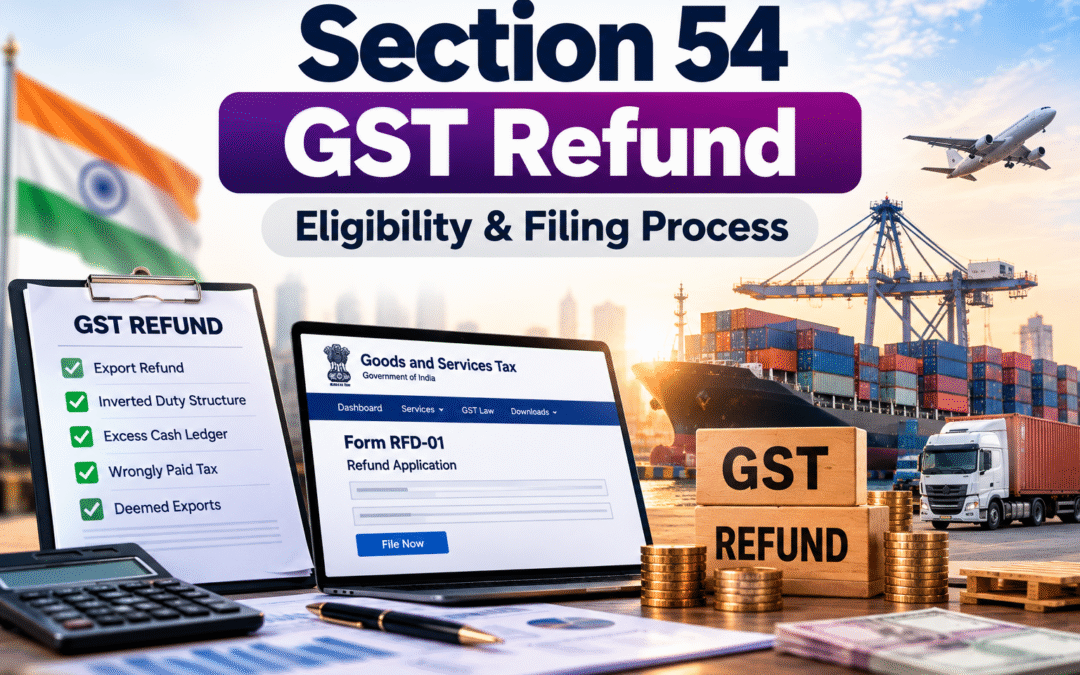
The main GST refund eligibility categories:
- tax paid on zero-rated supplies (exports and SEZ supplies, with or without payment of tax),
- accumulated ITC from an inverted duty structure,
- excess balance in the electronic cash ledger,
- tax paid under the wrong head (IGST instead of CGST/SGST),
- tax paid on deemed exports, and
- refunds from a favorable assessment, appeal, or revision order.
Each category has its own relevant date for the two-year window. Claims can also be bunched across financial years now – Circular 135/2020 dropped the earlier restriction.
One exclusion applies across categories: Section 54(15) bars any refund of unutilised ITC or IGST paid on zero-rated goods if those goods are subject to export duty. Excess cash ledger balance is exempt from the two-year window itself, since it isn’t really a refund of tax in the Section 54(1) sense. Closure of business isn’t a refund ground either – GST law has no provision for it.
The Refund Formula Under Rule 89
For zero-rated supplies without payment of tax, Rule 89(4) caps the refund at: Refund Amount = (Zero-Rated Turnover of Goods + Services) x Net ITC / Adjusted Total Turnover. Rule 89(5) applies a similar formula for inverted duty structure, netting out tax already payable on the inverted-rated supply so the refund reflects only genuine, accumulated credit. A rate change over time on the same goods isn’t inverted duty structure – Circular 135/2020 limits the category to a genuine, simultaneous input-output rate gap.
Can the Department Withhold a Sanctioned Refund?
Yes. Under Section 54(10), the officer can withhold or adjust your refund against unpaid tax, interest, or penalty if you’ve also defaulted on returns. Under Section 54(11)-(12), the Commissioner can withhold a refund under appeal in a fraud case if release would harm revenue – but you get 6% interest if you eventually win.
What Documents Do You Need to File?
Documents vary by category, but most claims share a common core.
- Form RFD-01, the refund application itself
- A statement of relevant invoices
- A CA/CMA certificate for claims below Rs 2 lakh, or a self-declaration above that (cash ledger refunds need neither)
- A declaration that the tax incidence hasn’t been passed on (except for zero-rated supplies)
- Shipping bills or bills of export for export-related claims
- The standardised Annexure-B statement for inverted duty structure claims, with invoice-wise and HSN/SAC detail
Incomplete or mismatched invoice data is the most common reason claims stall at scrutiny.
What Is the GST Refund Process Under Section 54, Step by Step?
The GST refund process runs electronically through Form RFD-01 on the GST portal, verified with a Digital Signature Certificate or Electronic Verification Code, and reviewed against a 15-day completeness check.
Once submitted, the officer has 15 days to issue an acknowledgement in Form RFD-02, or a deficiency memo in Form RFD-03 if something is missing. A deficiency memo gives you 15 days to respond with corrections – and it resets your application, so get the first submission right.
How Long Does It Take, and When Do You Get a Provisional Refund?
For zero-rated supply claims, up to 90% of the claimed amount can be sanctioned provisionally, often within days of acknowledgement – this to inverted duty structure claims too through Finance Act 2026.
Under Section 54(7), the officer must issue a final order within 60 days of a complete application. Interest becomes payable if the refund isn’t processed within that window, unless the delay is due to deficiencies on your end.
What Causes Refund Rejections or Delays?
- Common causes of delay or rejection: your invoices don’t match GSTR-2B/2A records, Annexure-B entries are missing or wrong, you picked the wrong refund category, or you didn’t reply to a deficiency memo within 15 days.
- Note: GSTR-2A matching doesn’t apply to ITC on imports, ISD invoices, or reverse-charge supplies – you can still claim these even if they don’t show up in your GSTR-2A.
Checklist Before You File a Section 54 Refund
- Confirm your refund category and relevant date for the two-year limit
- Reconcile claimed invoices against GSTR-2B/2A before filing, not after a deficiency memo
- Prepare the CA/CMA certificate where required, and Annexure-B via the offline utility for covered claims
- Gather shipping bills/bills of export for zero-rated supply claims
- File Form RFD-01 with DSC/EVC verification and retain the RFD-02 acknowledgement
- Calendar the 15-day response window in case a deficiency memo (RFD-03) is issued
- Track whether your claim qualifies for provisional refund or has been routed to scrutiny
- Monitor the 60-day final order deadline and note if interest becomes payable
FAQ
What is the time limit to file a Section 54 refund claim?
Two years from the relevant date, which varies by category – for exports it’s tied to shipment or receipt of payment; for deemed exports, it’s the date the supplier files their return, regardless of who claims the refund; excess cash ledger balance has no two-year limit at all.
Can I get a provisional refund before the final order?
Yes, for zero-rated supply claims – up to 90% can be sanctioned provisionally if your claim clears the automated risk check, with inverted duty structure claims set to qualify once the pending Finance Act 2026 amendment is notified. Flagged claims go straight to full scrutiny instead.
What happens if I get a deficiency memo?
You have 15 days to respond with missing documents or corrections via Form RFD-03. This restarts the completeness check, so review your original submission carefully rather than relying on the deficiency process to fix errors.
Is there a minimum refund amount under Section 54?
Yes – Section 54(14) still bars refunds under Rs 1,000 for most categories. A pending Finance Act 2026 amendment exempts only goods exported with payment of tax from this floor once notified; every other category keeps it.
Conclusion
Section 54 of CGST Act covers several distinct refund situations, each with its own documentation and deadline, and recent changes mean the GST refund process looks different than it did a year ago. Reconcile your invoices and category before you file, not after a deficiency memo. Unsure which category applies? Talk to Unnathi Partners before the two-year window closes.