 Chat on WhatsApp



TL;DR: If counterfeit versions of your trademark, design, copyright or GI keep turning up in import shipments, customs IPR recordation gets Customs to stop them at the port instead of chasing every consignment. It runs through ICeR portal registration under the IPR Rules, 2007, costs Rs. 2,000, and needs a bond plus indemnity bond. Patents fall outside these rules since 2018; trademarked parallel imports usually aren’t stoppable this way, though designs are.
What should you do?
- Brand owner facing counterfeit imports: file for customs IPR recordation now (process below) so Customs intercepts future shipments for you.
- Importer whose genuine goods just got suspended: check whether the right holder completed formal registration before assuming you’re stuck. Courts have repeatedly ordered release where Customs suspended goods on a bare complaint without it – see the case law below.
- Exporter facing counterfeit exports: ICeR recordation won’t help, since it covers imports only. Write to the jurisdictional Commissioner’s IPR cell with proof of your right and shipment details, citing Sections 11(2)(n) and 113 – see the exports section below.
What are the customs IPR enforcement rules (IPR Rules, 2007)?
Section 11 of the Customs Act, 1962 lets the government prohibit import of IP-infringing goods under clause (n). Notification No. 49/2007-Cus.(N.T.), later No. 51/2010-Cus.(N.T.), lists the prohibited categories; the Enforcement Rules, 2007 (No. 47/2007-Cus.(N.T.)) lay down the procedure. Notifications 56 and 57/2018-Cus.(N.T.) removed patents from both.
Recordation is a preventive tool, not a registration substitute – Customs enforces existing rights, it doesn’t adjudicate ownership.
Which IP rights can be recorded with Customs?
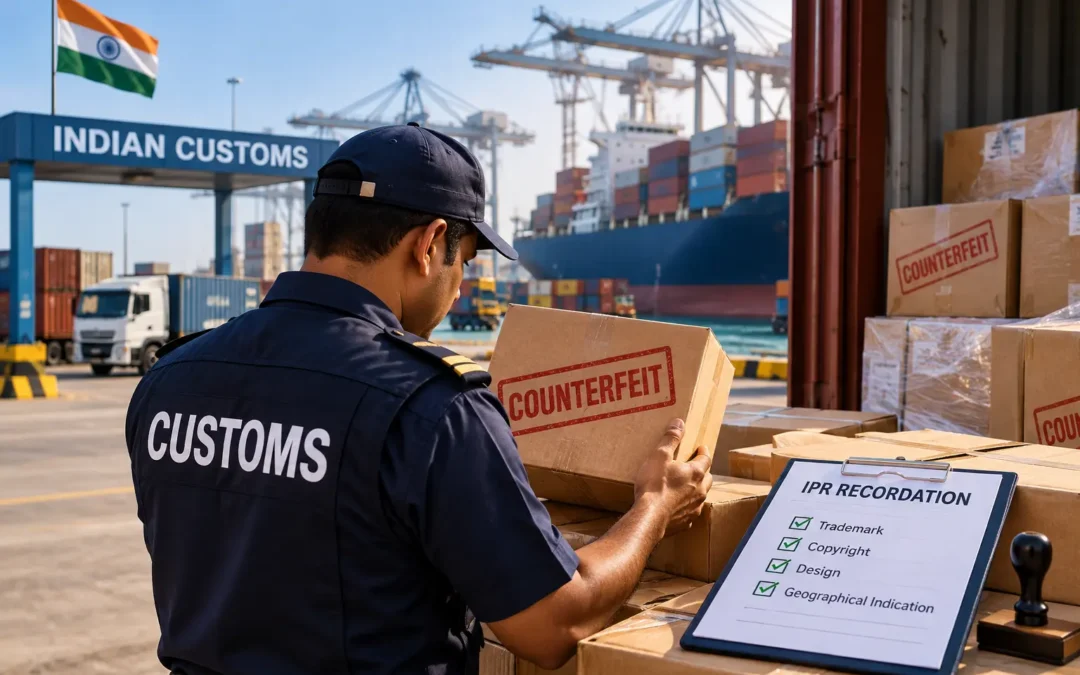
Customs IPR recordation is open to trademarks, copyrights, designs and GIs, but not patents – the 2018 amendments dropped them from the Rules and prohibition notification, so a patent holder’s remedies lie outside Customs.
| IP right | Can it be recorded with Customs? | Where recordation happens |
|---|---|---|
| Trademark | Yes | ICeR portal (ipr.icegate.gov.in) |
| Copyright | Yes | ICeR portal (ipr.icegate.gov.in) |
| Design | Yes | ICeR portal (ipr.icegate.gov.in) |
| Geographical Indication | Yes | ICeR portal (ipr.icegate.gov.in) |
| Patent | No – fully outside these Rules since 2018 | Not applicable – no customs route for patents at all |
ICeR portal registration: the recordation process, step by step
- File a notice naming every port (protection applies only there), using the prescribed format: applicant/IEC details, proof of ownership, grounds for suspicion, goods description with Tariff Heading.
- File electronically via ICeR (ipr.icegate.gov.in) with the Rs. 2,000 fee; you get a Unique Temporary Registration Number – acknowledgement only.
- Submit physical copies of the application, fee proof and bonds to the Commissioner’s office; a separate notice applies per right.
- Once satisfied, the Commissioner issues a Unique Permanent Registration Number (UPRN) – about 45-50 days in practice, longer than Rule 4(1)’s 30-working-day window; protection starts once issued.
Bond and security requirements
Registration needs two bonds: one for destruction, demurrage and detention costs, and an indemnity bond against a vexatious suspension. Use a General Bond plus a consignment-specific bond (110% of value, 25% security) within 3 days, or a Centralised Bond (25% security) valid everywhere. Valid for 5 years or until the IP right expires; refile before it lapses.
What happens when Customs suspects an infringing shipment?
Once a right is recorded, Customs suspends clearance of suspect goods and notifies the right holder at once, who gets 10 working days (extendable by 10) to join proceedings, or the goods are released. A suo motu suspension needs notice and bonds within 5 days; perishables get 3, extendable by 4. Confirmed-infringing goods are seized under Section 110, liable to confiscation under Section 111(d).
Disposal of infringing goods
Once confirmed infringing and confiscated, goods are destroyed or disposed outside normal trade channels after the right holder’s no-objection (deemed given after 20 working days of silence). Re-export unaltered isn’t permitted; costs fall on the right holder.
Does customs IPR recordation cover exports too?
The IPR (Imported Goods) Enforcement Rules, 2007 and ICeR recordation apply only to imports, per the Rules’ own short title. There’s no equivalent export portal or UPRN.
Customs does still act against outbound counterfeit shipments, just not through recordation. Section 11(2)(n) prohibits IP-infringing exports too, and Section 113 lets Customs confiscate goods improperly exported – usually a general seizure power plus an informal tip-off. An exporter should write to the jurisdictional Commissioner’s IPR cell, citing Sections 11 and 113.
Parallel imports under customs law in India: a right-by-right answer
Circular No. 13/2012-Cus. answers a recurring question: does recordation catch genuine parallel imports?
| IP right | Are genuine parallel imports treated as infringement? | Basis |
|---|---|---|
| Trademark | No, if lawfully acquired and not materially altered | Section 30(3)(b), Trade Marks Act, 1999 |
| Patent | No, if bought from a person duly authorised to sell | Section 107A(b), Patents Act, 1970 |
| Design | Yes, parallel imports are not permitted | Section 22(1)(b), Designs Act, 2000 |
| Geographical Indication | Act is silent – not addressed either way | GI Act, 1999 |
| Copyright | Decided case by case under the Act | Copyright Act, 1957 |
Baggage and de minimis imports (non-commercial goods in personal baggage or small consignments) fall outside the Rules, and Customs officers acting in good faith are protected from liability for a missed detection or inadvertent release.
Notable disputes under the Rules
UPS Sales v. Union of India, (2023) 9 Centax 4 (Bom.) : 2023 (386) E.L.T. 393 (Bom.), Bombay High Court, W.P. (L) No. 18061 of 2023, decided 11-7-2023: Customs suspended an “INGCO” trademark shipment on a rival’s complaint, with no registered notice or court order against the importer. The Court held this illegal – import is prohibited under Rule 6 only once the notice is registered (per NBU Bearings v. Union of India, Bom HC, 2021).
Raj Traders v. Commissioner of Customs, Ahmedabad, 2019 (370) E.L.T. 656 (Tri.-Ahmd.), CESTAT West Zonal Bench, Appeal Nos. C/10259-10261/2018, Final Order Nos. A/11006-11008/2018-WZB/AHD dated 14-5-2018: Sony panels were confiscated though the right holder never filed a notice or completed registration. The Tribunal set this aside – Customs’ jurisdiction is confined to the notice-and-registration procedure.
N.S. Plasters v. Principal Commr. of Customs, Chennai-II, 2017 (358) E.L.T. 71 (Mad.), Madras High Court, W.P. No. 5019 of 2017, decided 14-7-2017: after suspension was lifted under Rule 7(3) for the right holder not joining proceedings, Customs still refused a detention certificate over the bond obligation. The Court held the blameless importer was entitled to it regardless.
Jai International v. Commissioner of Customs, New Delhi, 2017 (352) E.L.T. 96 (Tri.-Del.), CESTAT Principal Bench, Appeal No. C/53309/2014-CU(DB), Final Order No. 50145/2016-CU(DB) dated 6-1-2017: unbranded motorcycle parts carried a counterfeit brand, liable to confiscation. Since the genuine supplier admitted a mistaken despatch, the Tribunal allowed re-export instead of destruction, subject to a Rs 1 lakh penalty.
Checklist for right holders before filing
- Confirm registration validity, list every port where infringing imports are likely, and keep the certificate and a packaging specimen.
- Decide between the general bond route or a centralised bond.
- Calendar the 5-year renewal date and bank guarantee window, brief the legal team on the 10-day response window (3 days for perishables), and report right-status changes within 1 month.
FAQ
Can patents be recorded with Indian Customs?
No. The 2018 amendments removed patents from the Rules and prohibition notification, so Customs has no route against them.
Is a genuine product bought abroad without the brand owner’s permission an infringing import?
Depends on the right – not for trademarks if genuine, but yes for designs; patents sit outside it.
What happens if the right holder does not respond to a suspension notice?
The goods are released – 10 working days (extendable by 10), 5 for a Customs-initiated suspension, 3 (extendable by 4) for perishables.
Does customs recordation protect against copying for export?
Not through ICeR – imports only. Customs can still seize outbound counterfeit goods under general powers.
Conclusion
For an importer or exporter dealing with counterfeit branded goods, customs IPR recordation is a low-cost, 5-year layer of protection alongside a trademark, design, copyright or GI registration – it doesn’t replace one, and works only at named ports. Get the bond structure right and track renewal. Grey-market worries differ by right: trademarked parallel imports usually aren’t stoppable this way, designs are, and patents sit outside this regime. Exporters, reset expectations – it doesn’t reach outbound shipments.
External reference: ICeR Portal, CBIC