 Chat on WhatsApp


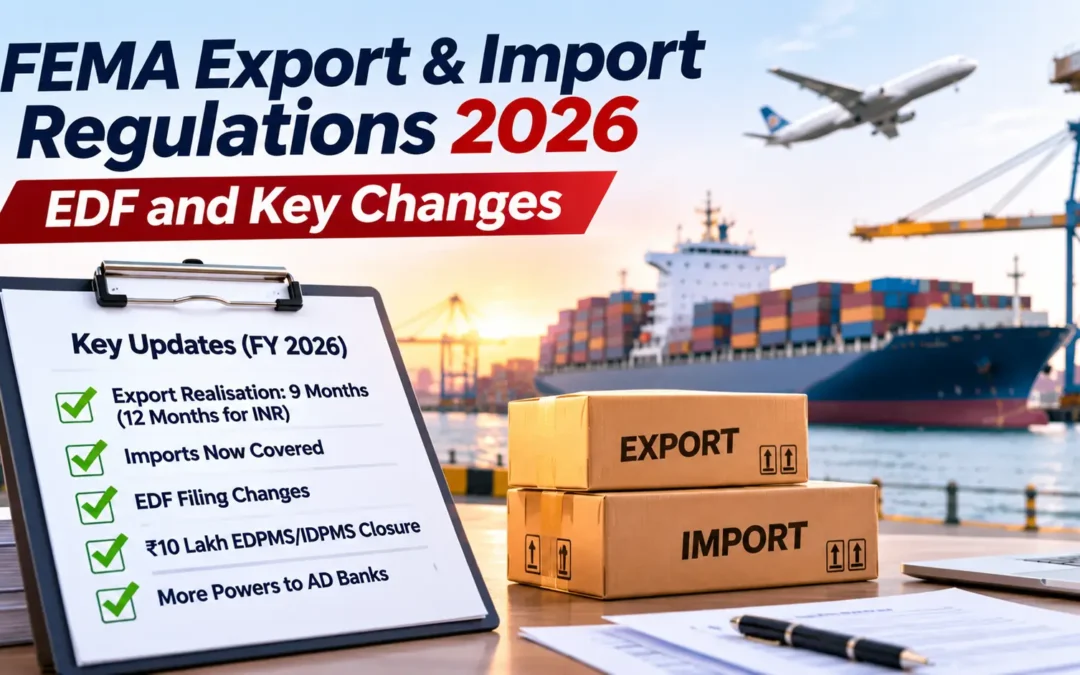
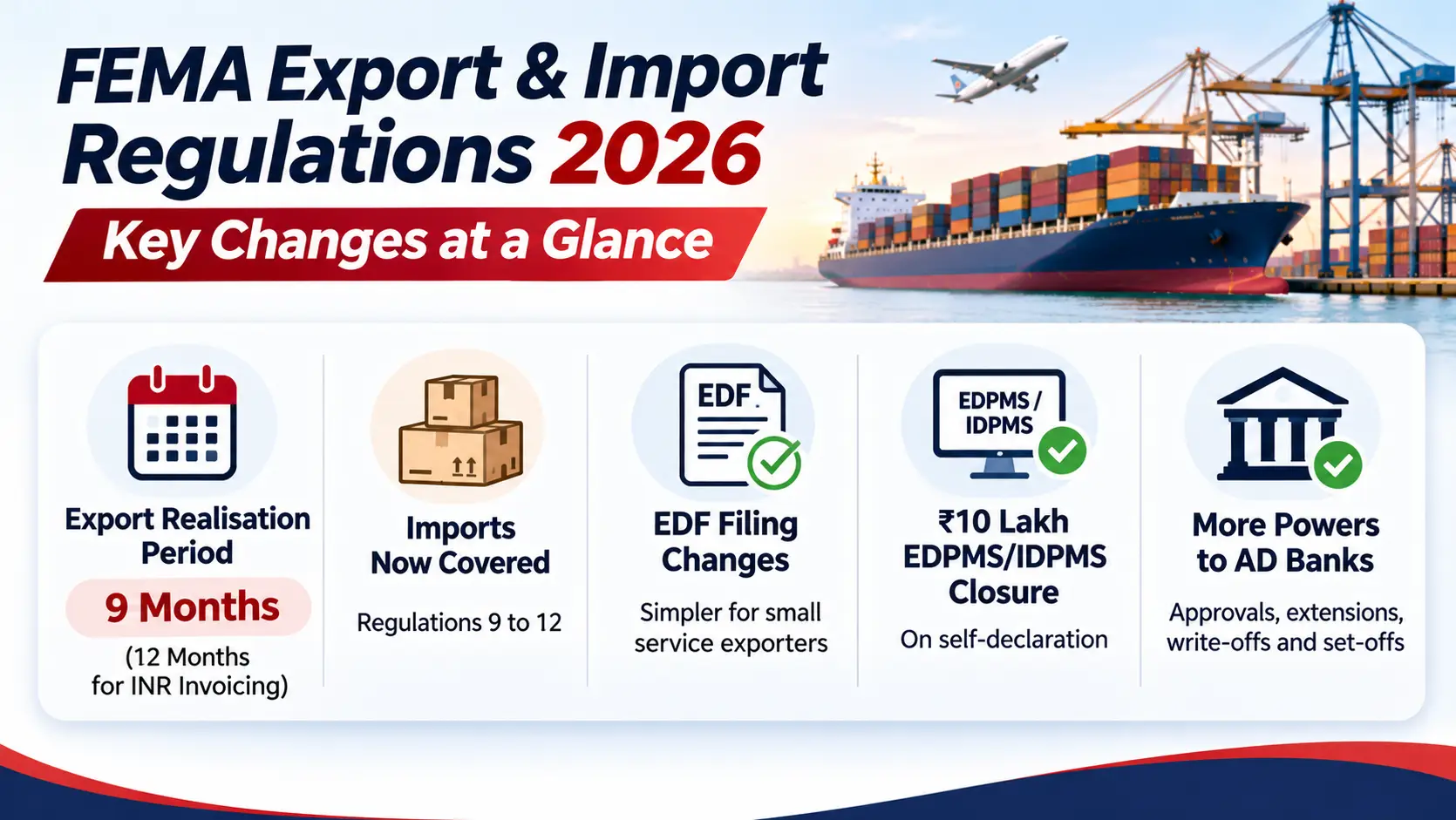
TL;DR: The FEMA export and import regulations 2026 (Notification No. FEMA 23(R)/2026-RB) took over from the 2015 export rules on 1 October 2026 and now cover imports too. Export proceeds must be realized within 9 months, or 12 if you invoice or settle in rupees. Your AD bank approves most things. Entries in EDPMS/IDPMS up to ₹10 lakh can be closed on your own declaration.
If you export from India, your payment clock just got shorter. It’s 9 months now, down from 15.
The Foreign Exchange Management (Export and Import of Goods and Services) Regulations, 2026 came into effect on 1 October. They replace the 2015 export rules and bring import payments into the same rulebook. The RBI notified them in January and has amended them twice since. The second amendment is dated 2 November but applies from 1 October, so it already covers your first month.
| Date | What happened |
|---|---|
| 13 Jan 2026 | RBI notifies FEMA 23(R)/2026-RB (gazetted 15 Jan). Realisation period: 15 months, or 18 for rupee exports. |
| 22 Sep 2026 | First Amendment, FEMA 23(R)/(1)/2026-RB (gazetted 24 Sep): cuts realisation to 9 and 12 months, adds the caution-list carve-out in Reg 13 and the AD bank powers in Reg 20. |
| 1 Oct 2026 | Regulations take effect. 2015 export regulations stand superseded. |
| 2 Nov 2026 | Second Amendment, FEMA 23(R)/(2)/2026-RB, removes separate EDF filing for most small service exporters. Applies from 1 Oct. |
New to the jargon? Here’s the short list.
- EDF: the Export Declaration Form, where you declare the value and details of what you export.
- EDPMS and IDPMS: the RBI’s Export and Import Data Processing and Monitoring Systems
- AD bank: the authorized dealer bank that handles your foreign exchange payment and receipt.
What are the FEMA export and import regulations 2026?
They’re the RBI’s rules for money coming in and going out on exports and imports of goods and services. They’re made under Sections 7, 8, 10(6) and 47(2) of FEMA, and they replace the 2015 export regulations, except for things done before 1 October.
In practice, four things change:
- Imports are inside the rulebook. Regulations 9 to 12 cover import payments, advances and imports that never arrive.
- Your AD bank decides more. It approves extensions, write-offs, set-offs and third-party payments (Regulations 5 to 8). It also handles pre-1 October transactions that needed RBI approval (Regulation 20).
- Up to ₹10 lakh per shipping bill, invoice or bill of entry, you can close EDPMS and IDPMS entries, and reduce export value, on your own declaration.
- Banks must put their rules in writing. Each needs a policy and standard operating procedure (SOP) with an escalation and appeal route, published on its website. Charges must be reasonable, and a bank can’t penalize you for your own regulatory delay or violation (Regulation 19).
What is the export realization period under the new rules?
You have 9 months to realize the full export value, meaning the money has to reach your account in India. For goods, the clock starts on the shipment date. For services, it starts on the invoice date (Regulation 5).
If you invoice or settle in rupees, you get 12 months. Your AD bank can extend either period if you give reasons.
| Type of export | Realization period | Counted from |
|---|---|---|
| Goods | 9 months | Date of shipment |
| Services | 9 months | Date of invoice |
| Goods to overseas warehouse | 9 months | Date of sale from such overseas warehouse (applicable in case of e commerce sales) |
| Project exports | As per contract | Contract terms |
| Invoiced or settled in INR | 12 months | Date of shipment or invoice |
Miss the date by a year and your next export gets harder. Under Regulation 13, once proceeds stay unrealized for more than a year past the due date (or the extended date), further exports go only against full advance or an irrevocable letter of credit (LC). Exporters on the RBI caution list on 30 September 2026 stay under that order until removed.
The 2015 rules still govern anything done before 1 October, and Regulation 20 lets banks handle older cases that needed RBI approval. But the text doesn’t say which realization period applies to shipments or invoices dated before that. If you have old receivables, check with your bank before you act on them.
Do service exporters still need to file an EDF?
Yes, unless it’s deemed filed.
For services, you file the EDF within 30 days from the end of the month in which you raised the invoice (Regulation 3(2)). Resident individuals, and other exporters receiving ₹10 lakh or less, are treated as having filed once they give payment details to their bank. Non-software service exporters can also file on or before the day payment arrives, and the bank can extend that deadline for good reasons. Service EDFs go to the AD bank, or to the AD bank or STPI (Software Technology Parks of India) for software exports.
For goods, the EDF is filed at the time of export. At EDI (electronic data interchange) ports, it’s deemed part of the shipping bill. At non-EDI ports, you file it with Customs or the SEZ Development Commissioner.
What did the November 2026 second amendment change?
It eases filing for small service exporters. A resident individual is treated as having filed the EDF once payment details go to the bank, whatever the amount. Other exporters get the same treatment if the inward remittance for the service is ₹10 lakh or less.
For service imports, the bank now enters IDPMS details only for non-individual importers with an invoice or contract value above ₹10 lakh.
How can exporters close EDPMS entries and reduce export value?
The ₹10 lakh limit is the most useful relief in the new rules. For each shipping bill, invoice or bill of entry up to that amount, you can close EDPMS and IDPMS entries and reduce or write off export value on your own declaration. Bulk closures every quarter are allowed. Above ₹10 lakh, the AD bank either verifies that the money was realized or paid or must be satisfied with your reasons.
Banks can also close entries where no export or import actually took place. Say you took an export advance, never exported, and can’t refund it. The bank can close the EDPMS entry on a reasoned request (Regulation 18(1)(i)). For imports, the bank can close an IDPMS entry where an advance can’t come back because no import happened, or where the import was settled at a reduced value (Regulation 18(1)(j) and (k)).
What changes for imports, merchanting trade and project exports?
- Payment period: as per the contract. The AD bank can extend it (Regulation 9).
- Advances: if you receive an export advance or pay an import advance, route it through one AD bank. You can switch if both banks are informed (Regulation 10(1) and (2)). For import advances, the bank may set a threshold above which it asks for a standby LC or guarantee (Regulation 10(3)).
- Gold and silver: no advance remittance (Regulation 11).
- Import not received: bring the advance back. If you don’t, or the IDPMS entry isn’t marked off, every future import advance needs an unconditional, irrevocable standby LC or a guarantee from an international bank of repute or an Indian AD bank (Regulation 12).
- Interest: on export advances or delayed import payments, it can’t exceed the trade credit all-in-cost ceiling (Regulation 10(4)).
- Merchanting trade: no more than 6 months between outward and inward remittance, extendable by the bank. Pay only the overseas seller and receive only from the overseas buyer, unless the bank allows a third party. Give the bank documents that evidence the transaction (Regulation 16).
- Project exports: the bank may permit receipts and payments as per the contract. A project exporter can park temporary cash surplus generated outside India in short-term instruments of up to 1 year, including treasury bills and bank deposits abroad (Regulation 15).
What should you do this month?
- Pull your bank’s EDPMS and IDPMS outstanding report.
- Flag entries that are nearing 9 months (12 for rupee exports).
- Ask for extensions early, with your reasons and documents ready.
- For entries up to ₹10 lakh, send the closure declaration. You can do it in bulk each quarter.
Frequently asked questions
When did the FEMA export and import regulations 2026 come into force?
On 1 October 2026.
What is the time limit to realize export proceeds now?
9 months from the shipment date for goods and the invoice date for services. For goods sent to an overseas warehouse, it runs from the date of sale. Rupee-invoiced or rupee-settled exports get 12 months. The AD bank can extend.
Do freelancers exporting services need to file an EDF?
No separate form is needed. From 1 October 2026, a resident individual is deemed to have filed the EDF once the payment details go to the AD bank for crediting the account. That holds whatever the invoice value. Other exporters get the same treatment only up to ₹10 lakh.
Can an exporter write off unrealized export proceeds?
Yes. Under Regulation 6, the AD bank may reduce the export value, including for non-realization, if it accepts your reasons. Up to ₹10 lakh per shipping bill or invoice, your own declaration is enough.
Get FEMA and export compliance support from Unnathi Partners
Tags: FEMA export and import regulations 2026, FEMA 23(R)/2026-RB, export realization period, EDPMS closure, IDPMS, EDF for export of services, deemed EDF, merchanting trade, FEMA second amendment 2026, AD bank


We're a tax and regulatory consulting firm in Bangalore. We advise startups, MSMEs and large corporates on GST, Customs, FTP, Income Tax and FEMA, and we handle the litigation too.
Reviewed By

Handles GST and Customs advisory, compliance and notice responses. Also leads client deliverables on our Tax and Regulatory assignments.

CA with 12+ years in GST, Customs and FTP, a decade of it at PwC, Deloitte and Economic Laws Practice. Sits on KSCAA’s Indirect Tax Committee and teaches at NACIN. Speaks regularly at DGTS outreach programs.