 Chat on WhatsApp


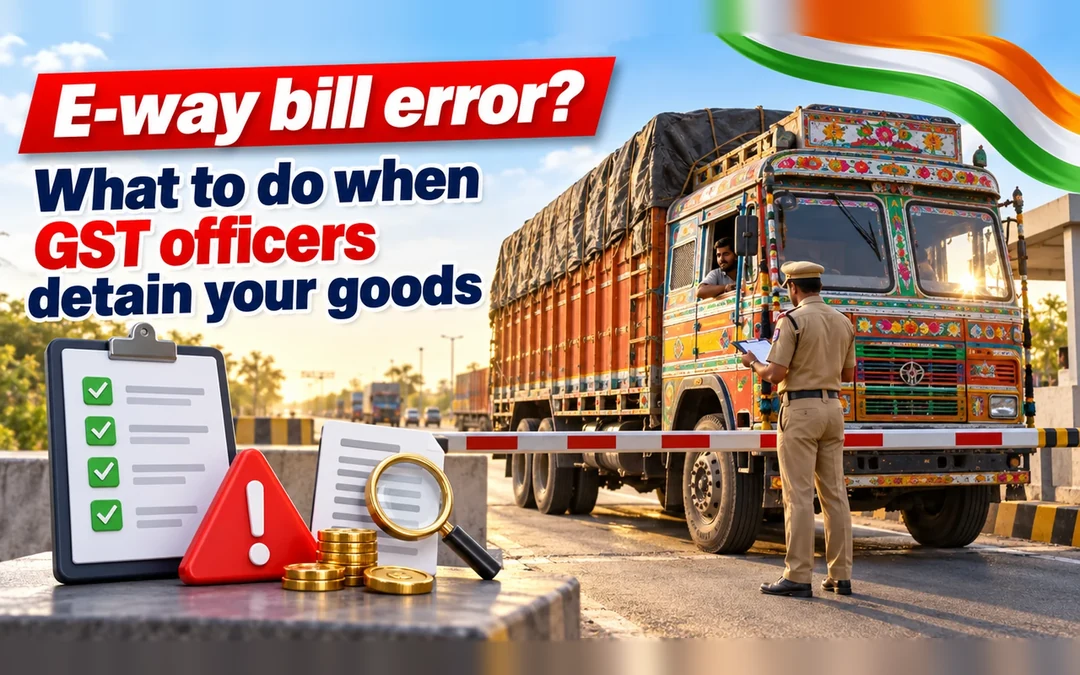
TL;DR: Most e-way bill errors, like a wrong PIN code, a 1-2 digit slip in the invoice or vehicle number, or a spelling mistake in a name with the correct GSTIN, are minor clerical slips, not evasion. CBIC Circular 64/38/2018-GST caps the penalty for these at ₹500 each under CGST and SGST (₹1,000 under IGST), not the 200% penalty under Section 129. If your truck is detained, don’t pay in a panic: check whether the error falls under the circular, respond in writing, collect every MOV form, watch the 7-day deadlines for the notice and order, and furnish security if you need the goods released fast. Better still, prevent the problem by matching the invoice and e-way bill before every dispatch.
A missed digit. A wrong PIN code. A delivery order that changed an hour before the truck left the gate.
That’s what most e-way bill errors look like. Not one of them means a rupee of tax went unpaid. Yet Section 129 lets officers hold the goods and the vehicle until a penalty of up to 200% of the tax is paid.
We see this with manufacturing and trading clients across Karnataka. The truck sits at a check-post, the transporter calls in a panic, and the business pays just to get moving. Often the law was on its side the whole time.
My view: most of these detentions are avoidable, and most of the penalties paid at check-posts shouldn’t have been paid. They usually start with 2 portals that don’t check each other.
Below, I’ll cover what the law says, what CBIC has clarified, what courts have held, and what to do before, and at, the check-post.
A ₹2 crore consignment, held over a typo
This one isn’t hypothetical. We’ve seen a ₹2 crore consignment stopped over a typing slip.
No tax was short. The goods matched the invoice. But the documents didn’t match each other, and that was enough to stop the truck.
Here’s the part businesses underestimate. The appeal can be won. But the working capital stays stuck for as long as the appeal runs, and the customer waiting for those goods doesn’t care who’s right.
So the real question for any dispatch team is simple: what does it take to stop the slip before the truck leaves?
What does the law say about goods in transit?
Short answer: A consignment worth more than ₹50,000 needs an e-way bill, and it must travel with the invoice or delivery challan. If the documents are missing or don’t match the goods, Section 129 lets officers detain both the goods and the vehicle. Release needs payment of the penalty, or security equal to it.
Here’s where each piece sits:
- Section 68 lets the government prescribe the documents goods must carry in transit.
- Rule 138 requires an e-way bill where the consignment value exceeds ₹50,000.
- Rule 138A says the invoice or delivery challan, and the e-way bill, must travel with the goods.
- Section 129 gives officers the power to detain and sets the penalty.
The penalty is steep on purpose:
| Situation | Penalty under Section 129 |
|---|---|
| Owner comes forward to pay | 200% of the tax payable |
| Owner doesn’t come forward | 50% of the value of the goods or 200% of the tax, whichever is higher |
That scale was built for evasion. A truck with no invoice at all is a serious problem. An invoice with a formatting slip is a much smaller one, and the law treats it that way, as you’ll see below.
Where does a clerical slip end and evasion begin?
The line is thinner than most businesses expect. 2 examples from practice show why.
An invoice reads 16/2024-25. The e-way bill reads 0162024-25. Same transaction, same value. The portals don’t cross-check, so the mismatch leaves with the truck.
Or a truck is booked to deliver to City A first, then City B. Traffic forces the driver to swap the order. The goods haven’t changed, and neither has the tax. Only the route moved.
In both cases, an officer could allege intent to evade and ask for 200%.
To be fair to officers, they have a job to do. The wrong invoice number could be an honest slip. It could also be one e-way bill used twice for 2 loads. From the roadside, those look the same, so they check.
Whether the penalty survives, an appeal is a separate question. By then, most businesses have already paid to release the truck. That’s why the cheapest fix is a documentation check at dispatch.
Which e-way bill errors does Circular 64/38/2018-GST cover?
Short answer: Circular No. 64/38/2018-GST, dated 14 September 2018, says Section 129 proceedings shouldn’t start where the e-way bill and invoice are valid but carry a minor error. Instead, the penalty is ₹500 each under the CGST and SGST Acts, or ₹1,000 under IGST, issued in FORM GST DRC-07.
The circular lists 6 errors:
- Spelling mistakes in the consignor’s or consignee’s name, where the GSTIN is correct
- An error in the PIN code, where the address is correct and the error doesn’t extend the e-way bill’s validity
- An error in the consignee’s address, where the locality and other details are correct
- An error in 1 or 2 digits of the document number on the e-way bill
- An HSN error at the 4- or 6-digit level, where the first 2 digits and the tax rate are correct
- An error in 1 or 2 digits or characters of the vehicle number
The invoice number example above falls under item 4.
Notice what the list has in common. In every case, the core facts are right: the right GSTIN, the right goods, the right tax. Only the details around them is wrong.
Field officers don’t always apply this circular. So keep a printed copy with your dispatch team, and cite it in writing at the check-post before anyone pays.

What happens at the check-post, step by step?
CBIC’s Circular No. 41/15/2018-GST sets out the procedure officers follow, using forms MOV-01 to MOV-11. Rules 138B and 138C give officers the power to intercept and verify, and say how an inspection gets recorded.
In practice, the sequence usually runs like this:
The driver’s statement is recorded in MOV-01.
If the officer wants a physical check, the order is issued in MOV-02.
The physical verification report is recorded in MOV-04.
If goods are held, the detention order is issued in MOV-06.
A notice under Section 129(3) follows in MOV-07.
Each of these is a paper trail. Ask for a copy of every form at every stage.
Why does this matter? Because if the officer skips a step in the Circular 41 procedure, the skipped step is itself a ground to challenge the detention. You can only point to the gap if you have the papers.
What have courts said about the Section 129 penalty?
High Courts have come back to 3 points again and again:
Intent matters.
A genuine clerical error, on its own, hasn’t been enough to sustain the maximum penalty. The department has to show the mismatch was deliberate.
Timelines are enforced.
Section 129(3) gives the officer 7 days from detention to issue a notice, and 7 days from service of that notice to pass the order. Courts have set aside late orders.
An expired e-way bill isn’t automatically fatal.
Without other signs of evasion, courts haven’t treated expiry alone as enough for the maximum penalty.
None of this excuses carelessness. The department still wins cases where the documents point to something more than a slip.
What the courts insist on is proportion. The penalty has to fit the facts, and a mismatch alone doesn’t prove the facts.
How do you get detained goods released without paying first?
Short answer: Section 129 lets you get the goods released by furnishing security equal to the penalty, in place of paying it. That gets the truck moving while you contest the detention. If the error falls under Circular 64, say so in writing at once and ask for the ₹500 penalty instead.
Here’s what I’d tell a client whose truck has just been stopped:
Don’t pay in a panic.
Check first whether the error is one of the 6 in Circular 64.
Put your reply in writing.
A phone call to the officer leaves no record. A short letter citing the circular does.
Collect every MOV form.
You’ll need them for the challenge, and for the timeline.
Watch the 7-day clocks.
Note the date of detention and the date the notice is served. A late notice or order is a ground of its own.
Use security if you must release fast.
It keeps your money from turning into a sunk cost while the dispute runs.
If the detention turns into a formal demand, our guide on how to respond to a GST notice covers the first steps.
How do you stop an e-way bill error before the truck leaves?
Short answer: Match the invoice and the e-way bill before dispatch, every single time. Most detentions we see trace back to manual re-typing at the dispatch desk, and that’s the easiest place to fix it.
5 habits that work:
Generate an e-way bill for every eligible shipment.
No exceptions for small or urgent loads.
Match invoice and e-way bill numbers before the truck leaves.
The portals won’t do it for you.
Automate where you can.
Software that pulls invoice data straight into the e-way bill cuts out re-entry, which is where most slips happen.
Train dispatch staff on documents along with logistics.
A short session every few months pays for itself the first time it stops a detention.
Add penalty-shifting clauses to transporter and supplier contracts.
If their error causes the detention, the cost should land with them.
The same document discipline protects you on customs too. Our guide on common customs duty savings covers that side. And since compliance and savings usually get reviewed together, our piece on GST savings most Indian businesses miss is worth reading alongside this one.
When should you call a GST e-way bill consultant?
Some detentions don’t hold up at all. A PIN code error with a correct address. A route change with no change in value. A portal glitch.
Businesses still pay first and contest later. That’s the moment to call someone.
A GST e-way bill consultant can tell you quickly whether your case falls inside Circular 64, or whether the department has a real point. That second answer matters too. If the department does have a point, you want to know before you spend 6 months fighting it.

The value of outside help is timing. Pushing back with the right circular and the right forms before payment costs far less than chasing a refund after it. Every day the truck sits, it costs you, in demurrage, in delayed delivery and in a customer who starts looking elsewhere.
Final word
Most e-way bill disputes start in the gap between what Section 129 allows and how it gets applied at a check-post. The ₹2 crore consignment held over a typo sat right in that gap.
The law protects businesses that make honest clerical errors. Circular 64 says so in plain terms, and the courts have backed it.
But that protection only helps if someone can point to it while the truck is still standing there. A printed circular, a dispatch checklist and a person who knows the MOV forms will do more for you than any appeal.
Ship goods regularly? Talk to us about reviewing your e-way bill process before it turns into a check-post problem.
This article is for general information only and is not legal advice.
Author: Pradeep Reddy, CA, Founder, Unnathi Partners (formerly PwC and Deloitte)
Frequently asked questions
Can officers detain goods for a spelling error in the invoice?
Not where the GSTIN is correct. Circular No. 64/38/2018-GST says Section 129 proceedings shouldn’t start for this. The penalty is ₹500 each under CGST and SGST, or ₹1,000 under IGST, issued in FORM GST DRC-07.
What is the penalty under Section 129 of the CGST Act?
200% of the tax payable if the owner comes forward. If the owner doesn’t, it’s the higher of 50% of the value of the goods or 200% of the tax. Goods are released on payment, or on security equal to the penalty.
Can I get detained goods released without paying the penalty?
Yes. Section 129 allows release if you furnish security equal to the penalty. That gets the truck moving while you contest the detention, without paying the penalty outright first.
How quickly must officers issue a penalty notice?
Within 7 days of detention, under Section 129(3). The order must follow within 7 days of the notice being served. Courts have set aside orders passed after these deadlines.
Does an expired e-way bill alone justify the maximum penalty?
Usually not. Courts have held that expiry alone, without other signs of evasion, doesn’t justify the maximum penalty. Keep a written record of why the delay happened, because you’ll need it.


We're a tax and regulatory consulting firm in Bangalore. We advise startups, MSMEs and large corporates on GST, Customs, FTP, Income Tax and FEMA, and we handle the litigation too.
Reviewed By

Handles GST and Customs advisory, compliance and notice responses. Also leads client deliverables on our Tax and Regulatory assignments.

CA with 12+ years in GST, Customs and FTP, a decade of it at PwC, Deloitte and Economic Laws Practice. Sits on KSCAA’s Indirect Tax Committee and teaches at NACIN. Speaks regularly at DGTS outreach programs.