 Chat on WhatsApp


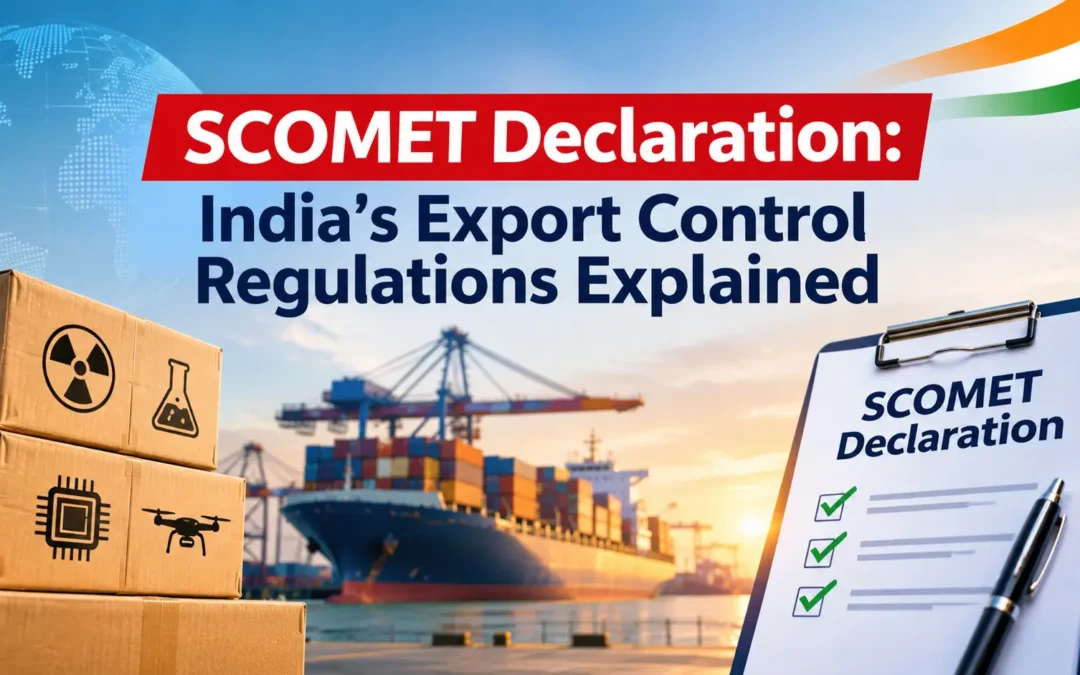
A valve you’ve exported for years can still be held at the port the day Customs suspects dual use.
Why? India controls exports of items that could feed weapons of mass destruction. And checking whether your product is covered falls on you, the exporter.
That check ends in a SCOMET declaration: your statement to Customs on whether the shipment contains a listed item.
What Is SCOMET?
SCOMET stands for Special Chemicals, Organisms, Materials, Equipment and Technologies. It’s India’s export control list for dual-use items, munitions and nuclear-related items. (Dual-use means a civilian product that could also feed a weapons programme.)
The Directorate General of Foreign Trade (DGFT) notifies the list as Appendix 3 to Schedule 2 (Export Policy) of ITC(HS) 2022. Under the Foreign Trade Policy 2023 (FTP), a SCOMET item is either prohibited or exportable only with an authorisation, unless exempted. The law sits in Chapter IVA of the Foreign Trade (Development and Regulation) Act, 1992 (FTDR Act).
It reaches well past nuclear items. It covers aerospace systems, advanced electronics, biotech, chemicals, software, encryption technology and even technical drawings. India uses it to keep such goods away from weapons of mass destruction programmes and their delivery systems, from military end use, and from non-state actors, including terrorists.
The rules follow India’s commitments under the Chemical Weapons Convention, the Biological Weapons Convention and UN Security Council Resolution 1540, plus its membership of the Missile Technology Control Regime, Wassenaar Arrangement and Australia Group.
What Is a SCOMET Declaration?
It’s your confirmation to Customs, filed with the shipping bill documents, on one question: is anything in this consignment on the SCOMET list?
If nothing is, you say so. If something is, you quote the authorisation number and details instead.
If the goods turn out to be listed, your statement becomes evidence against you. Do the classification work first, then sign.
SCOMET List: Which Items Are Covered?
DGFT revised the list through Notification No. 31/2025-26 (23 September 2025), effective 23 October 2025. It has 9 categories, numbered 0 to 8. Find the latest version on the DGFT website.
DGFT licenses Categories 1 to 5 and 8, centrally from its headquarters. The Department of Atomic Energy handles Category 0 and the Department of Defence Production handles most of Category 6.
A category tells you where to look. Whether your product is controlled depends on its technical specifications, its intended use and the exact control entry.
The list also moves. The 2025 revision added Category 7, so a product unlisted last year might be listed now. Recheck after each revision.
Chemicals and Related Materials
Category 1 covers toxic chemical agents and other chemicals.
Microorganisms and Biological Materials
Category 2 covers specified microorganisms and toxins.
Materials Processing and Manufacturing Equipment
Category 3 covers materials, materials processing equipment and related technologies.
Electronics, Computers, and Telecommunications
Category 8 covers specified electronics, computers, telecom and information security items.
Sensors, Lasers, and Navigation Equipment
Also Category 8, once performance crosses stated thresholds.
Aerospace, Propulsion, and Related Equipment
Category 5 covers aerospace systems, equipment and related technology, including UAVs. Category 8 picks up certain marine, aerospace and propulsion items.
Software and Technology
Software and technology are controlled too. Emailing design data to a buyer abroad can count as an export.
| Category | Examples (only if specifications match) | Why classification matters |
|---|---|---|
| 0 | Nuclear materials and equipment | Separate DAE route |
| 1 | Toxic chemicals, precursors | Purity and concentration matter |
| 2 | Listed microorganisms, toxins | The strain or toxin must be listed |
| 3 | Materials and materials processing equipment | Material grade and tolerances matter |
| 4 | Nuclear-related equipment outside Category 0 | Cross-check with Category 0 |
| 5 | Aerospace systems, UAVs | Range and payload thresholds apply |
| 6 | Munitions list items | Separate defence production route |
| 7 | Emerging technologies (new in 2025) | Semiconductor and quantum entries |
| 8 | Electronics, telecom, sensors, lasers, navigation | Performance parameters decide coverage |
When Does a SCOMET Declaration Apply?
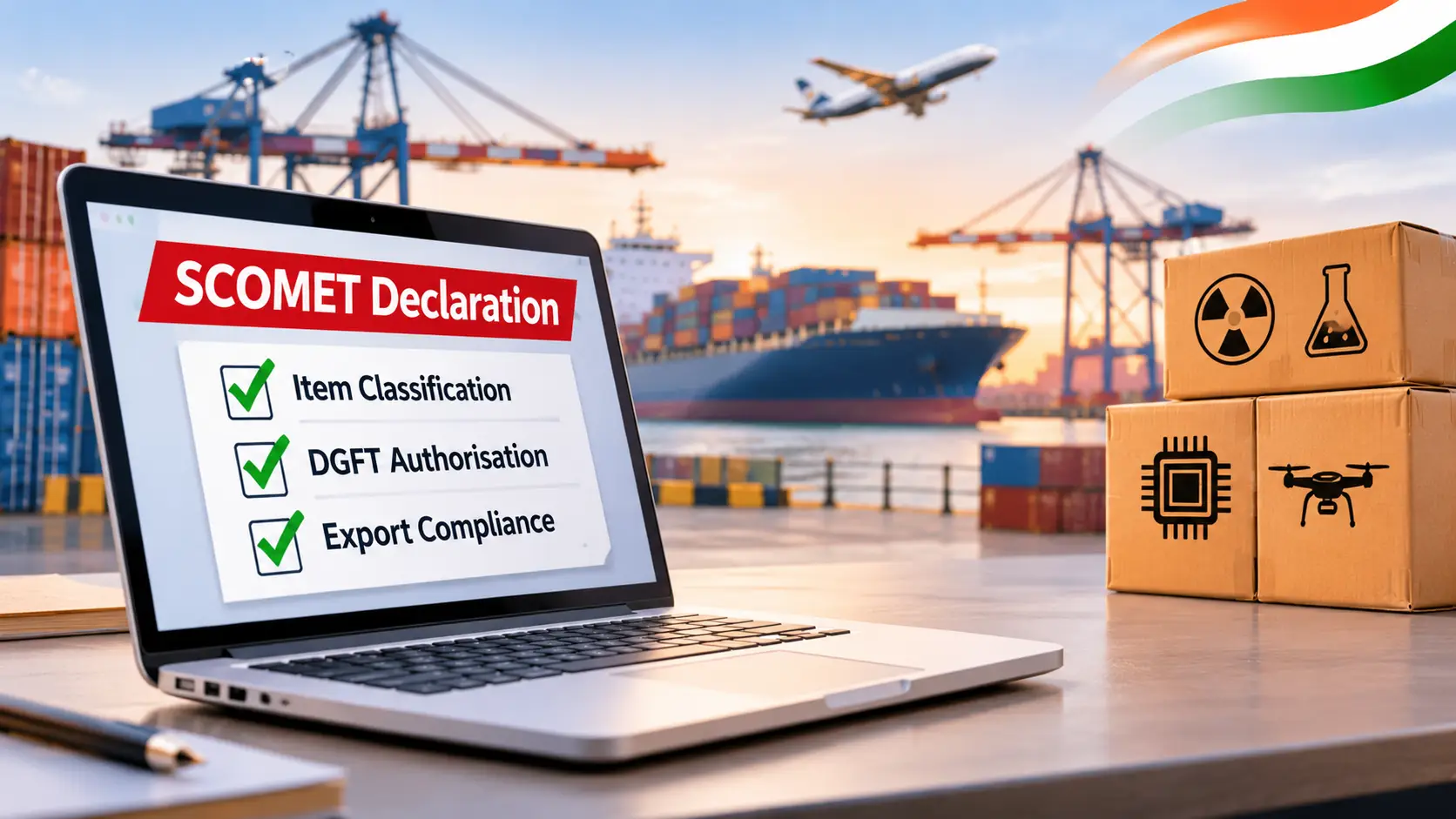
If your item matches a control entry, you need an export authorization before shipment. If it doesn’t, you confirm that in the export documents. What you need varies by item and transaction.
- Physical exports, including samples and exhibits
- Re-exports of imported SCOMET goods, even from a Customs bonded warehouse (FTP 2023, Para 10.07)
- Technology or software transfers by email, cloud access or technical assistance
- Transit, trans-shipment and brokering, which the WMD Act also covers (FTP 2023, Para 10.01)
- Supplies from the Domestic Tariff Area (DTA) to Special Economic Zone (SEZ) or Export Oriented Unit (EOU) units: no authorisation, but report to the Development Commissioner within 1 week (FTP 2023, Para 10.06)
Destination, end user and end use count, even for non-listed goods. FTP 2023 has a catch-all (Para 10.05): you need authorisation if DGFT notifies you, or if you know or have reason to believe the item may be used for weapons of mass destruction (WMD), missiles or military end use.
Who Should Be Aware of SCOMET?
Dual-use potential is the test. Check first if you export:
- Chemicals, biotech products or lab-grade reagents
- Electronic components, chips or aerospace equipment
- Drones, encryption-enabled devices or GPS technology
- Precision tools, materials or software
Legal, tax and compliance teams handling export documents or end-use certificates need it too, as do Indian subsidiaries of global companies shipping to sensitive markets.
How to Check Whether Your Product Falls Under SCOMET
Identify the Product’s Technical Specifications
Pull the datasheet: purity, materials, performance, software functions.
Review the Applicable SCOMET Category
Shortlist categories by what the product is and does.
Compare the Product Against the Control Entry
Match each parameter against the entry’s thresholds. SCOMET entries turn on specification, so the HS code alone won’t settle it.
Check End User, Destination, and Intended Use
Screen the buyer and end user against sanctions lists, and read the stated end use.
Confirm Whether Authorization Is Required
Listed in a DGFT category? Apply on the DGFT portal with form ANF-10A. Not listed? Record your classification and file the declaration.
FTP Para 10.08 lists the types, such as repeat orders, stock and sale, temporary export for exhibitions and export after repair. GAICT covers intra-company transfers of most Category 8 items (3 years); GAEC covers chemicals to specified countries (5 years).
| Step | Information required | Purpose |
|---|---|---|
| 1. Specifications | Datasheets, test reports | Establish the technical facts |
| 2. Category review | Current Appendix 3 | Narrow the possible entries |
| 3. Entry comparison | Parameters against thresholds | Decide listed or not |
| 4. End-use screening | Buyer, end user, destination | Run catch-all checks |
| 5. Authorisation decision | Classification note | Declare or apply to DGFT |
Stuck on step 3? Check the current DGFT rules and get a written opinion before you ship. We prepare these regularly, so talk to us first.
Documents and Information Required for SCOMET Compliance
The exact set depends on the SCOMET category and the DGFT procedure.
- Product description and technical specifications
- Applicable SCOMET classification details
- Exporter and consignee information
- End-user details and end-use statement, where required
- Destination country and shipment details
- Supporting documents for the relevant authorisation or declaration
What Happens If SCOMET Requirements Are Not Followed?
The penalty under Section 11(2) of the FTDR Act starts at ₹10,000 at the low end and goes up to 5 times the value of the goods or technology at the top.
Section 14E hands contraventions on specified items to the Weapons of Mass Destruction and their Delivery Systems (Prohibition of Unlawful Activities) Act, 2005 (WMD Act). Section 16 of that Act sets a fine of ₹3 lakh to ₹20 lakh for unauthorised export, and 6 months to 5 years in prison for repeat offences. The goods can be seized or returned at Customs, and your Importer Exporter Code (IEC) can be suspended or cancelled.
Already shipped something listed? FTP Para 10.11 encourages voluntary self-disclosure and promises strict action otherwise. DGFT’s SOP (Public Notice 40/2024-25) explains how.
Common Mistakes to Avoid in SCOMET Declarations
- Assuming a product is exempt because it’s commercially available
- Relying only on the HS code
- Using an outdated SCOMET list
- Giving incomplete or inaccurate specifications
- Ignoring end-user and end-use requirements
- Assuming a declaration replaces an export authorisation when one is required
Not sure your declarations would survive a Customs query? Send your export product list to Unnathi Partners and we’ll review it.
Frequently Asked Questions
What Is SCOMET Meaning in Export Trade?
SCOMET stands for Special Chemicals, Organisms, Materials, Equipment and Technologies. It’s India’s list of dual-use, munitions and nuclear-related items.
What Is a SCOMET Declaration?
It’s the exporter’s confirmation, filed with the shipping bill, that the goods are off the SCOMET list or are exported under a valid DGFT authorisation.
Where Can I Find the Official SCOMET List?
On the DGFT website (dgft.gov.in) under Regulatory Updates, “Import, Export and SCOMET Policy”.
Which Items Require SCOMET Authorization?
Anything matching a specific entry in Categories 0 to 8.
Is a SCOMET Declaration Mandatory for All Exports from India?
No single form exists for non-listed goods, but Customs, carriers and couriers routinely ask for a non-SCOMET declaration. Listed goods need an export authorisation first.
What Is the Difference Between a SCOMET Declaration and a SCOMET Licence?
A declaration is your own statement about the goods. A licence is the export authorisation (from DGFT, DAE or DDP, by category) you need before exporting a listed item.
How Can I Check Whether My Product Falls Under SCOMET?
Compare its specifications with the current Appendix 3 entries, then screen destination, end user and end use.
Get SCOMET Compliance Assistance from Unnathi Partners
Unnathi Partners is a Bengaluru-based Customs, GST and Foreign Trade Policy advisory firm. We review product classifications, explain the documents you need, assess export controls and handle DGFT filings.
Unsure whether your product or technology is covered? Contact us before it ships.
This article is for general information only and is not legal advice. Verify current DGFT rules before acting.
Author: Pradeep Reddy, CA, Founder, Unnathi Partners. Formerly at PwC and Deloitte.
Tags: SCOMET, SCOMET declaration, SCOMET list, export control India, DGFT, dual-use items, Foreign Trade Policy 2023, export compliance, ITC(HS) Appendix 3, export authorisation


We're a tax and regulatory consulting firm in Bangalore. We advise startups, MSMEs and large corporates on GST, Customs, FTP, Income Tax and FEMA, and we handle the litigation too.
Reviewed By

Handles GST and Customs advisory, compliance and notice responses. Also leads client deliverables on our Tax and Regulatory assignments.

CA with 12+ years in GST, Customs and FTP, a decade of it at PwC, Deloitte and Economic Laws Practice. Sits on KSCAA’s Indirect Tax Committee and teaches at NACIN. Speaks regularly at DGTS outreach programs.