 Chat on WhatsApp


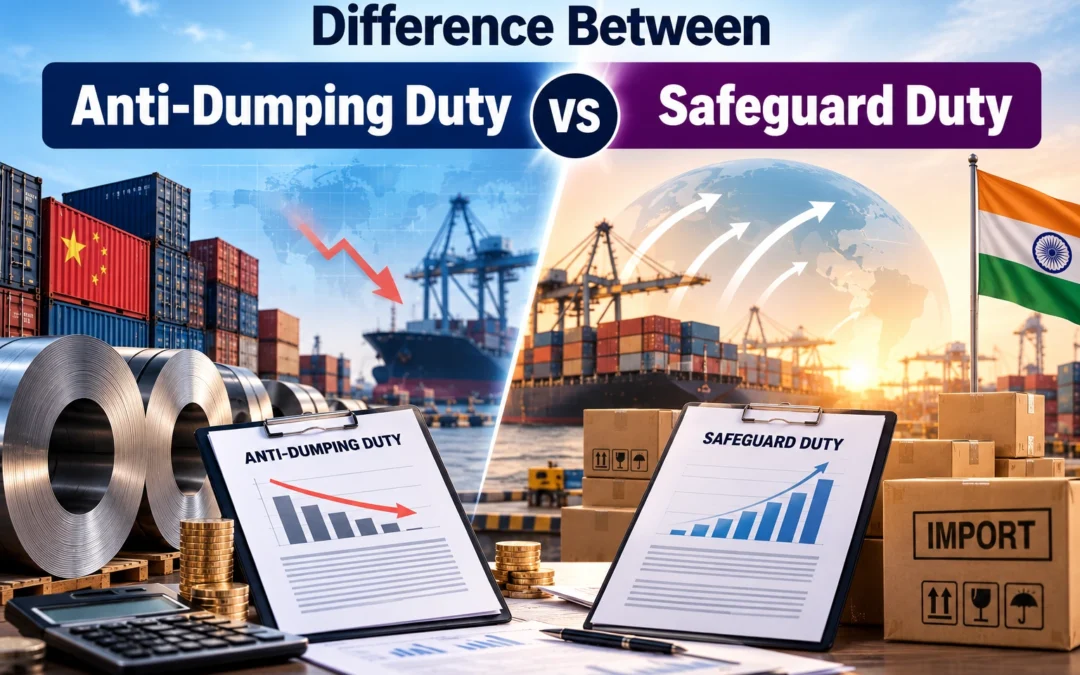
TL;DR: The difference between anti dumping duty and safeguard duty comes down to what each responds to. Anti dumping duty India targets goods sold below normal value by a specific foreign exporter, applied country- and company-wise after proving dumping and injury. Safeguard duty India is a temporary, non-discriminatory response to a sudden import surge, applied uniformly regardless of where goods come from or whether pricing was unfair. Both are trade remedies investigated by DGTR, but they answer different questions and hit your import bill differently.
Why the distinction matters right now
In April 2025, India imposed a safeguard duty of up to 12% on select flat steel products for three years, tapering to 11.5% and then 11% through April 2028 – applied to imports from nearly every country, regardless of pricing. Around the same time, DGTR recommended a 5-year anti dumping duty specifically on Chinese electrical steel, based on evidence that Chinese exporters were pricing below normal value.
Two different duties, two different legal tests, live on overlapping product categories in the same year. If your business imports steel, chemicals, or any product subject to trade remedy action, this difference changes how you plan sourcing and pricing.
For example, an importer sourcing flat steel from multiple countries in 2025 had to check two separate notifications on the same HS code: a broad safeguard duty applying to nearly all origin countries, and a narrower anti-dumping duty applying only to specific Chinese exporters.
What is anti dumping duty?
Answer: Anti dumping duty is imposed under Section 9A of the Customs Tariff Act, 1975, when a specific foreign exporter sells goods in India below normal value, causing or threatening injury to domestic industry. It applies exporter-by-exporter, not across the board.
The duty is calculated to close the gap between export price and normal value – typically the price in the exporter’s home market – known as the dumping margin. DGTR investigates by comparing normal value, export price, and injury over a defined period, then recommends a duty rate that can vary by exporter. Some companies from the same country may face a different rate, or none at all, based on pricing behavior.
Pending a final finding, the government can levy duty on a provisional estimate; if the final margin is lower, the excess is refunded. In rare cases involving a history of dumping or a sudden import surge, the duty can apply retrospectively, up to 90 days before notification. EOU and SEZ units are exempt by default, unless the notification specifically covers them or goods clear into the domestic tariff area.
What is safeguard duty?
Answer: Safeguard duty is imposed under Section 8B of the Customs Tariff Act, 1975, when a sudden, sharp rise in imports from any source causes or threatens serious injury to domestic producers. Unlike anti dumping duty, there’s no need to prove unfair pricing.
The steel example makes this concrete: DGTR found flat steel imports rose from 2.29 million tonnes in 2021-22 to 6.61 million tonnes in the investigation period, a surge serious enough to justify a duty applied to imports from virtually all countries equally, not targeted at specific exporters.
The same provisional-duty and EOU/SEZ logic applies here: a provisional safeguard measure runs up to 200 days pending final determination, refunded if no injury is found, and EOU/SEZ imports are exempt by default unless specifically covered or cleared into the domestic tariff area. Safeguard measures cap at four years initially, extendable but never beyond ten years total – and developing countries are excluded below a 3% individual or 9% combined import-share threshold.
The difference between anti dumping duty and safeguard duty: legal and procedural
Anti dumping investigations require establishing dumping, injury, and a causal link between the two. Safeguard investigations require showing an import surge and serious injury or its threat – pricing behavior isn’t part of the test.
Both are investigated by DGTR, under the Ministry of Commerce, but anti dumping cases typically run longer given the need to establish exporter-specific normal values, while safeguard investigations move faster since they center on import volume trends.
| Feature | Anti-Dumping Duty | Safeguard Duty |
|---|---|---|
| Legal basis | Section 9A, Customs Tariff Act 1975 | Section 8B, Customs Tariff Act 1975 |
| Trigger | Unfair pricing by a specific exporter | Sudden surge in import volume |
| Applies to | Named country/exporter | All countries, non-discriminatory |
| Typical duration | 5 years, sunset review option | Temporary, degressive rate |
How long do these duties last, and how are they reviewed?
Anti dumping duty is typically imposed for five years, with a sunset review option to extend it if dumping and injury are likely to continue. Safeguard duty is meant to be temporary and degressive – the rate reduces over its term, as seen in the steel case’s step-down from 12% to 11% across three years, and it generally can’t be reimposed on the same product for a period after it lapses.
Anti dumping duty can be reviewed mid-term through a new shipper review or changed circumstances review if an exporter’s pricing changes, which safeguard proceedings don’t typically involve.
Which duty applies to your imports?
Check the product-specific customs notifications on your HS code – both duty types are notified separately, and a product can have safeguard duty from one investigation and anti-dumping duty on specific countries from a separate one, as with steel in 2025. Don’t assume clearing one type means you’re clear of the other.
If you manufacture under MOOWR, both duties can be deferred rather than paid upfront – MOOWR covers anti-dumping and safeguard duty alongside basic customs duty, IGST, and cess, payable only if finished goods clear for domestic sale, and not at all if exported.
Checklist for assessing exposure
- Identify the exact HS code and confirm whether it’s subject to any current DGTR notification
- Check separately for anti dumping notifications (country- and exporter-specific) and safeguard notifications (broad-based)
- Confirm the exporting country and specific exporter against any anti dumping duty table
- Note the duty’s expiry or step-down schedule so landed cost stays current
- Watch for sunset review notices near the five-year anti dumping mark
- Confirm whether an EOU/SEZ exemption or provisional-duty refund applies to your imports
- Review DGTR and CBIC notifications periodically for new investigations on your product category
FAQ
Can a product be subject to both anti dumping and safeguard duty at the same time?
Yes, if separate investigations conclude with separate findings – as with certain steel products in 2025, where safeguard duty applied broadly while anti-dumping duty targeted specific Chinese exporters. Check both notification types for your HS code.
Who investigates anti dumping duty India and safeguard duty India cases?
The Directorate General of Trade Remedies (DGTR), under the Ministry of Commerce and Industry, investigates both and recommends duty rates to the Ministry of Finance, which issues the final notification.
How is the safeguard duty rate decided?
DGTR assesses the size of the import surge and resulting injury, then recommends a duty designed to give domestic industry time to adjust – typically structured to reduce over the safeguard period rather than stay fixed.
Does safeguard duty India apply to all countries equally?
Generally yes – it’s meant to be non-discriminatory, though developing countries are excluded below a 3% individual or 9% combined import-share threshold.
Can importers represent to the government to reduce or eliminate these duties?
Yes. Importers are recognised as interested parties in DGTR investigations and can file submissions, request a sunset or changed-circumstances review, or seek an end-use exemption. Representations work better backed by evidence – user industry impact data or pricing changes – than a general objection.
Conclusion
The difference comes down to this: anti dumping duty answers whether a specific exporter is pricing unfairly, while safeguard duty answers whether import volume is hurting domestic industry. They’re investigated by the same authority but rest on different evidence and timelines. If your product category has been through a DGTR investigation, get your HS code and supplier checked against both duty tables by Unnathi Partners before you finalize landed cost.
DGTR – Directorate General of Trade Remedies, official portal