 Chat on WhatsApp



TL;DR: Authorized Economic Operator (AEO) certification comes down to how much site-inspection scrutiny you can pass right now and how much working-capital benefit you need. AEO tier 1 is a desk-based entry tier, lighter on paperwork after annexures were cut from 7 to 2; AEO tier 2 adds deferred duty payment and mutual recognition but needs a physical site audit; AEO tier 3 opens after two clean years as a T2 holder, or sooner via qualifying business partners. You do not have to start at T1 – apply directly for T2 if you already meet the higher AEO certification requirements.
Introduction
Most businesses default to AEO tier 1 simply because it is the entry point, without checking whether transaction volume and cash-flow pressure justify the extra scrutiny of tier 2. That is not always wrong, but it is often unexamined. Some exporters would clear a T2 site audit today and are leaving deferred-duty benefits on the table; others apply prematurely and stall at inspection because internal controls are not documented yet. This guide covers what changes between the tiers, whether you can skip to a higher one, and a checklist to sanity-check your choice.
A Quick Illustration
An exporter with three years of clean filing history and a documented warehouse security process could reasonably apply direct for T2 rather than parking at T1 for a year. A business with no documented cargo-handling procedure is better off starting at T1 and using that period to get audit-ready.
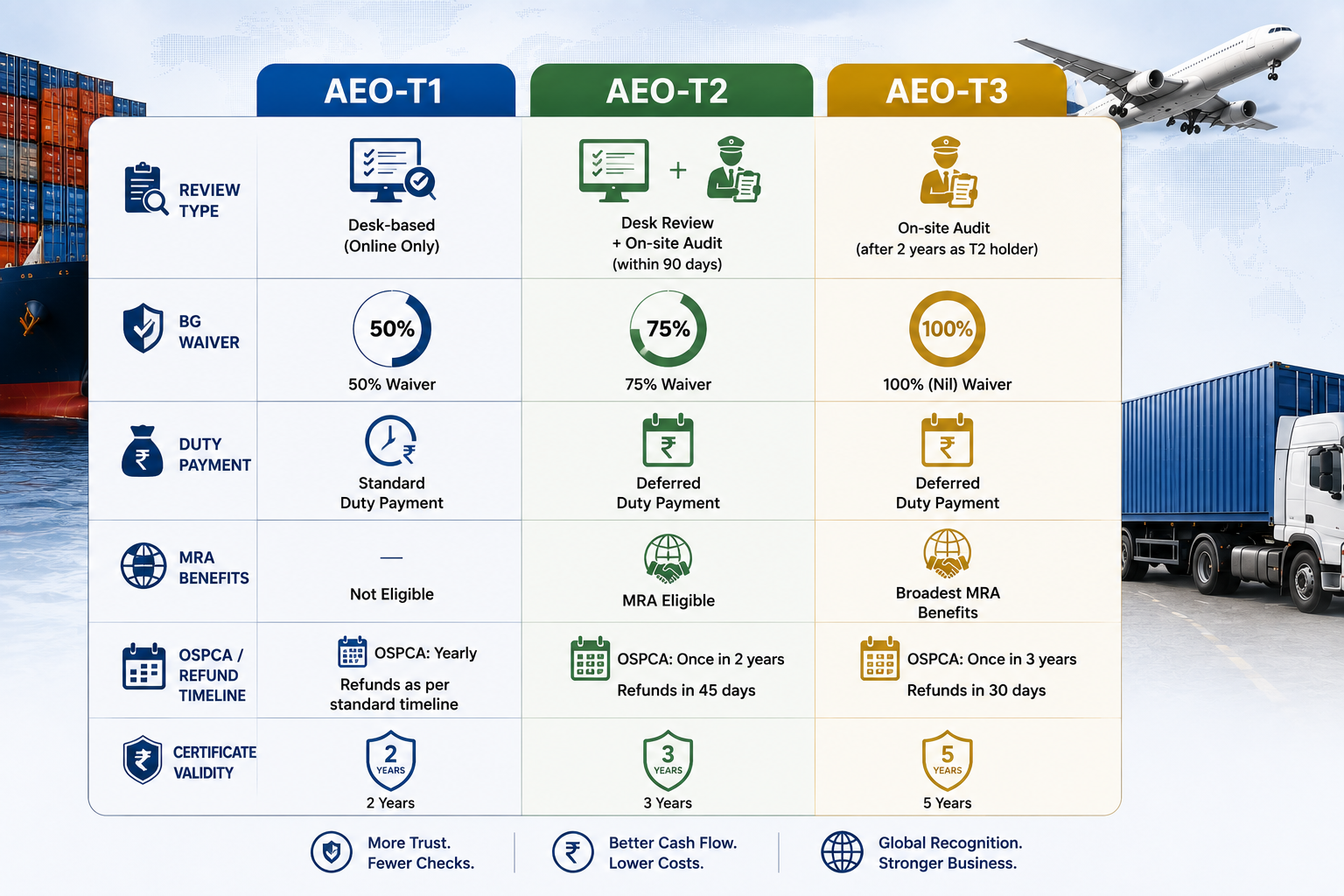
AEO T1 T2 T3 Benefits Comparison
Each tier trades scrutiny for benefit – more paperwork and a physical audit buy faster cash conversion, lighter audit frequency, and mutual recognition abroad.
| Tier | Review type | BG waiver / Duty payment | OSPCA (On-Site Post Clearance Audit) / Refund timeline |
|---|---|---|---|
| AEO-T1 | Desk-based, online only | 50% waiver, standard duty timing | OSPCA yearly |
| AEO-T2 | Desk review plus on-site audit within 90 days | 75% waiver, deferred duty, MRA eligible | OSPCA once in 2 years, refunds in 45 days |
| AEO-T3 | On-site audit, only after 2 years as T2 | 100% (nil) waiver, deferred duty, broadest MRA | OSPCA once in 3 years, refunds in 30 days |
- OSPCA (On-Site Post Clearance Audit) is CBIC’s premises-based check verifying that your documented security, cargo-handling, and internal controls match ground reality. Frequency tracks trust: yearly for T1, once every two years for T2, once every three years for T3.
- Deferred duty payment, unlocked from T2 onward, delinks duty payment from clearance – goods leave port before duty is paid, settled periodically instead, much like GST. It is usually the first benefit businesses feel, freeing up working capital that would otherwise sit locked at the port.
- Mutual Recognition Agreement (MRA) benefits, also unlocked at T2, extend that trust abroad: partner customs administrations recognise CBIC’s AEO status, giving T2 and T3 holders fewer inspections and faster clearance overseas too, not just at Indian ports.
- Certificate validity scales too: 2 years for T1, 3 for T2, 5 for T3 – renew 30, 60, or 90 days before expiry respectively.
Do You Have to Start at T1, or Can You Apply Directly for T2?
No. T2 eligibility largely mirrors T1 plus extra documentation, so businesses with mature internal controls can apply directly for T2, skipping T1 entirely.
The difference is verification, not eligibility: T1 is reviewed on paper, while T2 and above require a physical site audit within 90 days covering premises security, cargo handling, and personnel vetting. Apply direct if those systems are already documented; otherwise, T1 is a lower-stakes way to get comfortable with CBIC’s process.
Which Tier Fits Your Business Right Now?
- Apply for T1 if you are newer to compliance documentation or your working capital isn’t especially sensitive to duty-payment timing
- Apply for T2 if deferred duty payment would meaningfully help cash flow, control procedures are already documented, and you trade with MRA-covered countries
- Hold off on AEO tier 3 until you have held T2 for two years with a clean record, unless key business partners already hold AEO-T2/LO status, which opens an earlier route
- Logistics providers, Customs brokers, custodians, and warehouse operators sit outside the T1-T3 ladder, under a separate Logistics Operator category with its own waivers
What Does the AEO Application Process Look Like?
- Submit the T1 application through the aeoindia.gov.in portal with Annexure A-1 and the self-assessment questionnaire.
- A jurisdictional AEO Programme Manager reviews the T1 application on paper, usually within one to three months – approvals now sit with Zonal Customs rather than a central authority.
- T2 and T3 applications add a physical site visit within 90 days, where the inspecting officer checks whether what you claimed on paper matches what is actually happening at your premises.
- Overall processing runs two to four months to certificate.
- If you have already held T2 continuously for two years, T3 issues within 30 days without a fresh audit.
- Businesses that fail a T2 audit are usually rejected because documented procedures do not match what the inspector sees – preventable if you audit yourself honestly first.
What Is the Real Cost of Choosing the Wrong AEO Tier?
Applying too low leaves benefit on the table – slower cash conversion, no MRA recognition abroad. Applying too high costs more.A failed or stalled site audit flags your compliance record, making CBIC warier next time.
AEO Certification Checklist by Tier
- Confirm base eligibility: 3 years of activity (2 for MSMEs) and 25+ customs documents filed
- Estimate how much deferred duty payment would actually improve working capital
- Check whether trading partners are in Mutual Recognition Agreement countries
- Honestly assess whether security and internal-control procedures are documented, not just practiced
- Walk your own premises as if you were the inspecting officer, before CBIC does
- Decide whether to apply direct for T2 or build a T1 track record first
- If applying for T2 or T3, prepare for a site audit within 90 days of filing
- Calendar renewal filing 30/60/90 days before your certificate’s expiry, by tier
FAQ
What is the difference between AEO T1 and T2?
Mainly documentation and verification. AEO tier 2 eligibility largely mirrors tier 1 with added documentation, and there’s no rule forcing you to hold T1 first – the tradeoff is a physical site audit that T1 does not require.
How long does it take to move from T1 to T2?
There’s no fixed timeline, but many businesses target T1 by their third year and upgrade to T2 within 12 to 18 months once internal-control documentation and site-readiness catch up.
What happens if I apply for a tier my business is not ready for?
The application typically stalls at the site-audit stage rather than being rejected for ineligibility, and a failed audit can make CBIC more cautious next time – self-audit honestly first.
Does choosing a lower tier limit future upgrades?
No. Starting at T1 does not cap you – you can upgrade to T2 whenever ready, and T3 remains available once you have held T2 for two years, or sooner if key business partners already hold AEO-T2/LO.
Conclusion
AEO T1 vs T2 vs T3 is not a ladder you climb one rung at a time – it is a match between how much scrutiny your business can pass today and how much benefit you need. Most exporters get this wrong in one of two directions: staying at T1 too long, or reaching for T2 before their controls can survive a site audit.
Internal reading: see our posts on AEO certification in India, SEZ compliance in Bangalore, and GST refunds for exporters.
External reference: CBIC – Official AEO India Portal – aeoindia.gov.in