
 Chat on WhatsApp




TL;DR: A GST show cause notice (SCN) gives you 30 days to reply in Form DRC-06 – but first check if the SCN is even valid (DIN, signatory, procedural timelines). If valid, reconcile the discrepancy, decide whether to fight or pay, and file a point-by-point reply backed by law and evidence before the deadline.
A GST show cause notice usually lands as an intimation in DRC-01A, followed by a formal notice in DRC-01, and most business owners either ignore it or respond to it with a one-line denial. Both reactions are costly: the officer must pass an order if you don’t respond, and a vague show cause notice reply gives them nothing to work with. This guide covers what a show cause notice is, how to check its validity, the deadlines, how to reply to a show cause notice in the correct GST notice reply format, and when to fight versus pay.
For example: an SCN alleges ITC mismatch between GSTR-3B and GSTR-2B. Part of the gap is a genuine timing difference (vendor filed late); part is an ineligible credit missed on reversal. A DRC-06 reply that separates the two, with evidence, fares far better than a blanket denial or admission.

What Is a Show Cause Notice, and Is Yours Valid?
A show cause notice asks you to explain why tax, interest, or penalty shouldn’t be demanded – and one with a missing DIN or wrong signatory can be invalid on its face. Check this first, because a procedural defect can kill the notice before you argue the merits.
- Does the SCN carry a DIN? Every Central GST SCN needs a Document Identification Number per CBIC Circular 128/47/2019-GST – no DIN, or an unverifiable one, is a ground to challenge validity.
- Is the signatory the proper officer? An SCN signed by an officer without jurisdiction over your case is void – verify the signing officer’s designation against your notified jurisdiction (you can find it under your profile section once you login to GST portal.)
- If the SCN follows an audit, was it completed within 3 months? Section 65(4) caps an audit at 3 months from commencement, extendable only with valid recorded reasons – an SCN built on a time-barred audit is challengeable.
- Was Form ADT-02 issued within 30 days of audit conclusion? The audit report (ADT-02) must reach you within 30 days of conclusion under Section 65(6) – a late ADT-02 is a timing non-compliance ground to flag.
How Much Time Do You Have to Reply to a GST SCN?
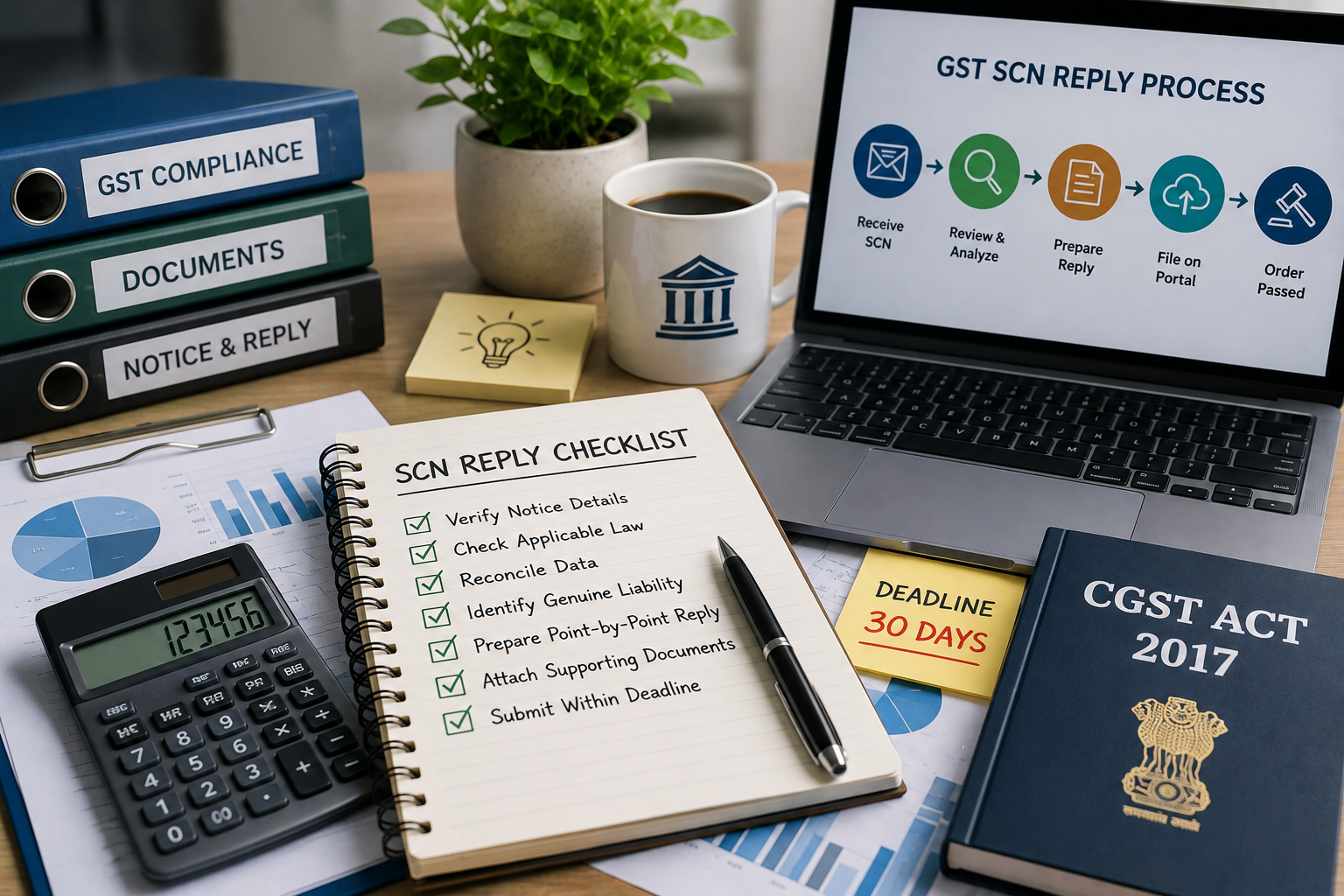
You generally have 30 days from service of the notice to reply in Form DRC-06 on the GST portal, whether issued under Section 73 (genuine errors) or Section 74 (fraud or wilful suppression).
Under Section 74A, applicable from FY 2024-25, the window for reduced-penalty benefits extends to 60 days. Missing the deadline doesn’t end the matter but lets the officer pass a DRC-07 demand order on the notice alone, with no record of your side.
Section 73 vs. 74 vs. 74A: Which One Applies to You?
The section under which your notice is issued sets the penalty exposure, so check it first, not last.
| Section | Applies to | Penalty if paid within 30 days of SCN | Coverage period |
|---|---|---|---|
| Section 73 | Genuine errors, no fraud | 10% of tax or ₹10,000, whichever is higher | Up to FY 2023-24 |
| Section 74 | Fraud, suppression, wilful misstatement | 25% of tax | Up to FY 2023-24 |
| Section 74A | Unified provision, fraud and non-fraud | Extended 60-day window, lower slab | FY 2024-25 onwards |
If the department has invoked Section 74 for what is genuinely a clerical error, contest that explicitly – the burden is on the officer to establish fraud, not just assert it.
How to Reply to a Show Cause Notice in the Correct Format
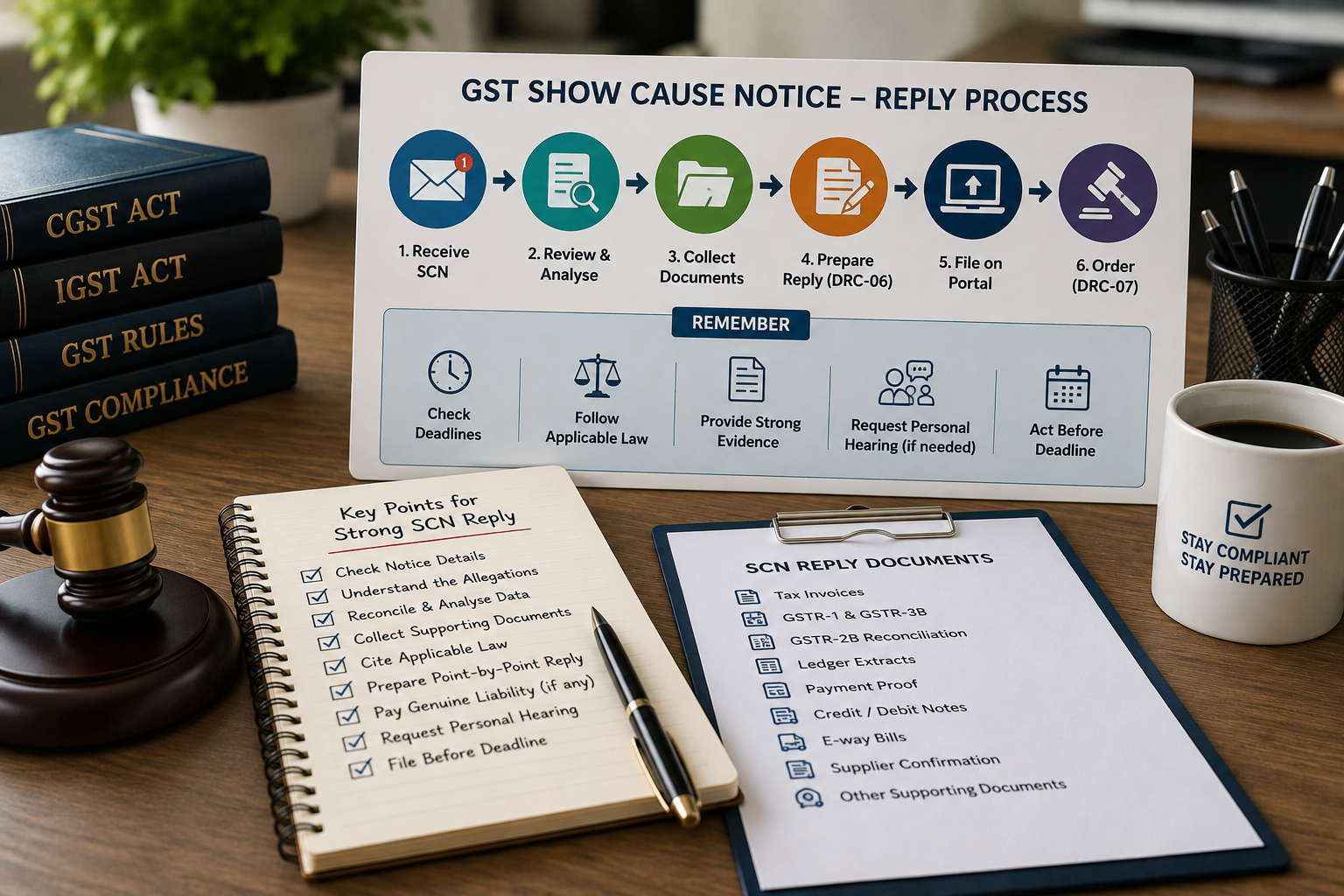
The GST notice reply format is fixed: log in to the GST portal, open Services > User Services > View Notices and Orders, and file against the DRC-01 reference number. A reply that holds up rests on law, evidence, and structure, not just the format.
- State your position line by line – accept, contest, or partially accept each item, not a blanket denial
- Back every contested point with legal basis – cite the Sections, CBIC circulars, judgements, and GST Council minutes that support your reading
- Attach documentary evidence – invoices, e-way bills, GSTR-2B extracts, and a reconciliation statement for every contested figure
- Get a technical expert certificate for classification disputes – a chartered engineer or product-specialist opinion carries real weight
- Pay the genuinely payable portion via Form DRC-03 before or alongside your reply – it reduces the penalty slab
- Tick the personal hearing box in DRC-06 itself – easy to miss, and skipping it can mean no hearing
Should You Fight the Notice or Pay Up?
If the department’s case is weak on facts or law, contest it; if the demand is genuinely valid, pay early and use Section 73(5) to close the matter with a lower penalty – litigation isn’t always the smarter route.
Weigh the evidence strength against the cost of contesting versus the tax at stake. A validity defect or an arguable legal position is worth fighting with citations. A clear liability is cheaper to close: pay tax and interest under Section 73(5) and the penalty is waived.
GST SCN Reply Checklist
- Confirm the SCN has a valid DIN and was signed by the proper jurisdictional officer
- Check DRC-01A preceded DRC-01, and that any audit or ADT-02 timelines were met
- Confirm the section invoked (73, 74, or 74A) and reconcile each discrepancy against your books
- Decide, item by item, what to contest and what to pay via DRC-03
- Draft a point-by-point reply citing sections, circulars, and judgements, with evidence attached
- Tick the personal hearing box and file before the 30-day (or 60-day, under 74A) deadline
What Happens If You Miss the Deadline or Reply Poorly?
If no reply is filed, the officer can pass an ex-parte order in Form DRC-07 confirming the demand as proposed, with interest and the maximum penalty. A poorly structured reply – one that doesn’t address each allegation with law and evidence – often gets the same result even if filed on time.
Once DRC-07 is issued, recourse shifts to a statutory appeal under Section 107 – its own 3-month deadline, plus a mandatory pre-deposit of the disputed tax.
Internal reading: see our guides on Section 54 GST refund eligibility and filing, choosing the right GST litigation consultant, and SVB customs rules and clearance process for related compliance topics.
FAQ
Can I get an extension to reply to a GST SCN?
Extensions aren’t guaranteed but can be requested through the portal or in writing, citing genuine cause such as pending reconciliation. Officers have discretion to grant short extensions before the 30-day window lapses.
What if the SCN has no DIN – can I ignore it?
No – raise the DIN defect explicitly in your reply rather than ignoring the notice, since silence still risks an ex-parte order. Courts have quashed SCNs without a valid DIN, but the objection must be on record.
Can the demand be dropped entirely?
Yes – under Section 73, paying tax, interest, and a 10% penalty within 30 days of the SCN concludes proceedings. Under Section 74, similar conclusion is possible at reduced penalty slabs if paid within the specified windows.
Conclusion
A GST show cause notice isn’t a bill – it’s an allegation the department has to support procedurally and on the merits. Businesses that come out ahead check validity first, reconcile the numbers, and file a structured DRC-06 reply inside the 30-day window.